

“I don’t have a mom,” the little girl whispered as she slid onto the bench beside me in the park.
At first, I figured she just wanted someone to notice her.
Emily ended up staying there far longer than she’d intended. She called the café to confirm that Lily’s grandmother could still see them from inside. Then she returned with two cold lemonades. Lily began recounting an elaborate, theatrical tale about a classmate who had stolen her crayons “on purpose.” For once, Emily didn’t check the time.
They strolled along the riverwalk, careful not to wander beyond sight of the café windows. Lily skipped ahead, occasionally slipping her hand into Emily’s without warning. Each time, Emily’s shoulders tensed—yet she didn’t pull away.
“What do other grown-ups sound like?” Emily asked gently.
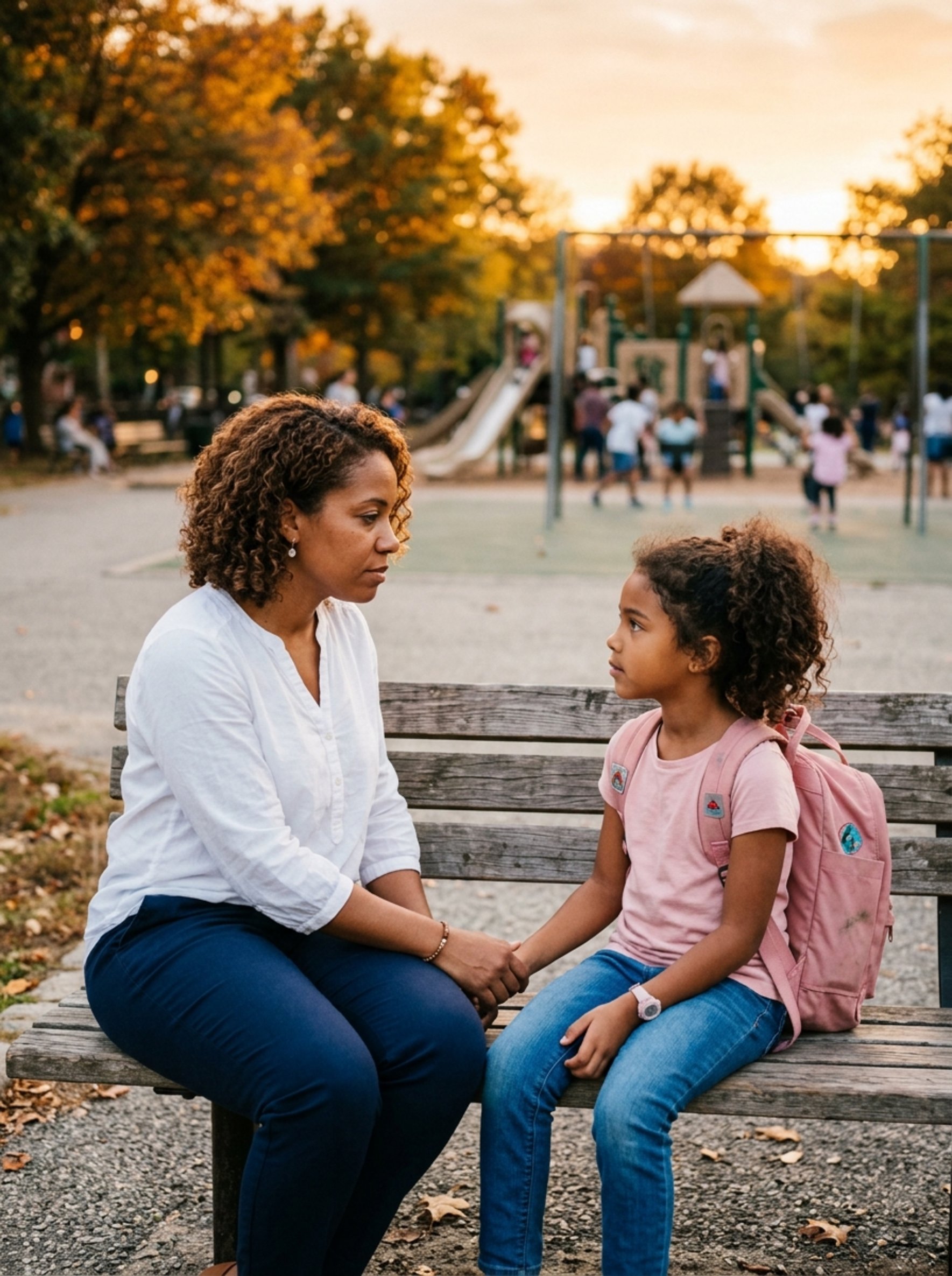
“Like they’re thinking about somewhere else,” Lily replied.
The answer landed hard because it felt accurate.
Lily referred to her mother only once. “She got sick,” she said quietly, eyes fixed on the rippling water. “And then she didn’t come back.” Her voice carried no tears, just plain fact.
Emily didn’t probe further.
“She still loves me,” Lily added with a small shrug. “She’s just tired.”
Something inside Emily loosened at those words. She found herself remembering her own childhood—years filled with every comfort except the steady presence of parents who were truly there.
The memory lingered with Emily—of a childhood filled with advantages and opportunities, yet strangely empty of real closeness. She had climbed ladders quickly, achieving more than most, but never learned how to simply sit beside another person and share their hurt.
When the café door finally swung open and Margaret, Lily’s grandmother, stepped onto the sidewalk, Emily rose instinctively.
Without a trace of hesitation, Lily slipped her arms around Emily’s waist.
Emily stiffened in surprise, then, after a heartbeat, gently rested her hand against the child’s back.
Margaret watched the exchange with quiet interest. “Lily doesn’t usually do that,” she remarked softly.
They exchanged phone numbers—no grand declarations, no elaborate plans. Just a simple agreement to stay connected.
That night, back in her apartment, Emily noticed the stillness felt altered. It wasn’t peaceful. It was empty.
She glanced down and saw the thin pink ribbon from Lily’s backpack still looped around her finger.
Sitting on the edge of her couch, Emily wept—for the first time in years.
She didn’t turn into a savior. She didn’t adopt a child or overhaul her world in a dramatic sweep.
Instead, she chose something quieter—and far more demanding.
She kept coming back.
It started with Sundays: slow walks through the park, library visits, ice cream only after homework was done. Always with Margaret’s knowledge. Always transparent. Always careful.
Soon, Lily began waiting by the café window, watching for her.
One afternoon, Lily looked up at her and asked, “Will you ever stop coming?”
Emily didn’t hesitate. “If that ever happens,” she said gently, “you’ll hear it from me first.”
Lily studied her face for a moment, then gave a small, satisfied nod. “Okay. That’s fair.”
Time moved forward in quiet increments. Weeks folded into months.
Emily rearranged her calendar without making an announcement about it. She began trusting the people she managed instead of hovering over every detail. Responsibilities she once clutched tightly were handed off. In doing so, she uncovered hours—and emotional space—she hadn’t realized she was starving for.
At Lily’s school play, the auditorium buzzed with chatter and rustling programs. When Lily stepped onto the stage, her eyes immediately swept the crowd. The instant she found Emily, her entire face lit up. She waved with such unrestrained excitement that her teacher had to gently lower her arm and guide her back into position.
Later, someone remarked how much Emily’s presence must have changed the child’s life.
Emily only shook her head softly. “No,” she replied. “She changed mine.”
Over time, she learned something success had never taught her: achievements don’t quiet loneliness. Titles and accolades can fill a résumé, but they don’t fill an empty room.
What eases that ache is connection—messy, sincere, beautifully human connection—and the choice to keep showing up.
During the year I survived out of my car with my baby tucked against my chest at night, the world kept spinning with its endless stream of drama. One afternoon, when a police officer called me down to the station and disclosed something that made my knees buckle, I realized how fragile anyone’s stability can be.
Everywhere I looked, there were stories more shocking than the last. An eight-year-old girl asking a wealthy tycoon to choose between her and his fortune. A mother frantically searching for her sixteen-year-old son, only to learn from his teacher that he had turned in an essay titled, “Mom, It’s Time You Knew Everything.”
There were tales of in-laws demanding repayment for a mysterious “family debt,” husbands confessing in hushed tones that an apartment had been purchased under their wife’s name—leaving her responsible for the installments. Sisters calling at midnight, urging secrecy and sending siblings creeping into attics to uncover hidden truths beneath loose floorboards. Women ordered into guest rooms while pregnant relatives smirked, suggesting they should simply pack up and disappear before the weekend.
Pain, betrayal, desperation—they weren’t rare tragedies. They were everywhere. And sitting in that stark police office, I understood that my story was about to join them in a way I never could have imagined.