
You set the canvas tote on the glass coffee table as deliberately as someone delivering a final invoice. The apartment is modest in size, yet arranged with calculated care to suggest money—gold-framed photographs, an immaculate white sofa, a scented candle trying a little too hard to signal refinement. Behind Michael, his lover stands frozen in a silk nightgown, a spoon suspended above an open yogurt cup, as if even time has stalled.
Michael’s gaze drops to the wheelchair, then shifts to you, and finally to his mother.
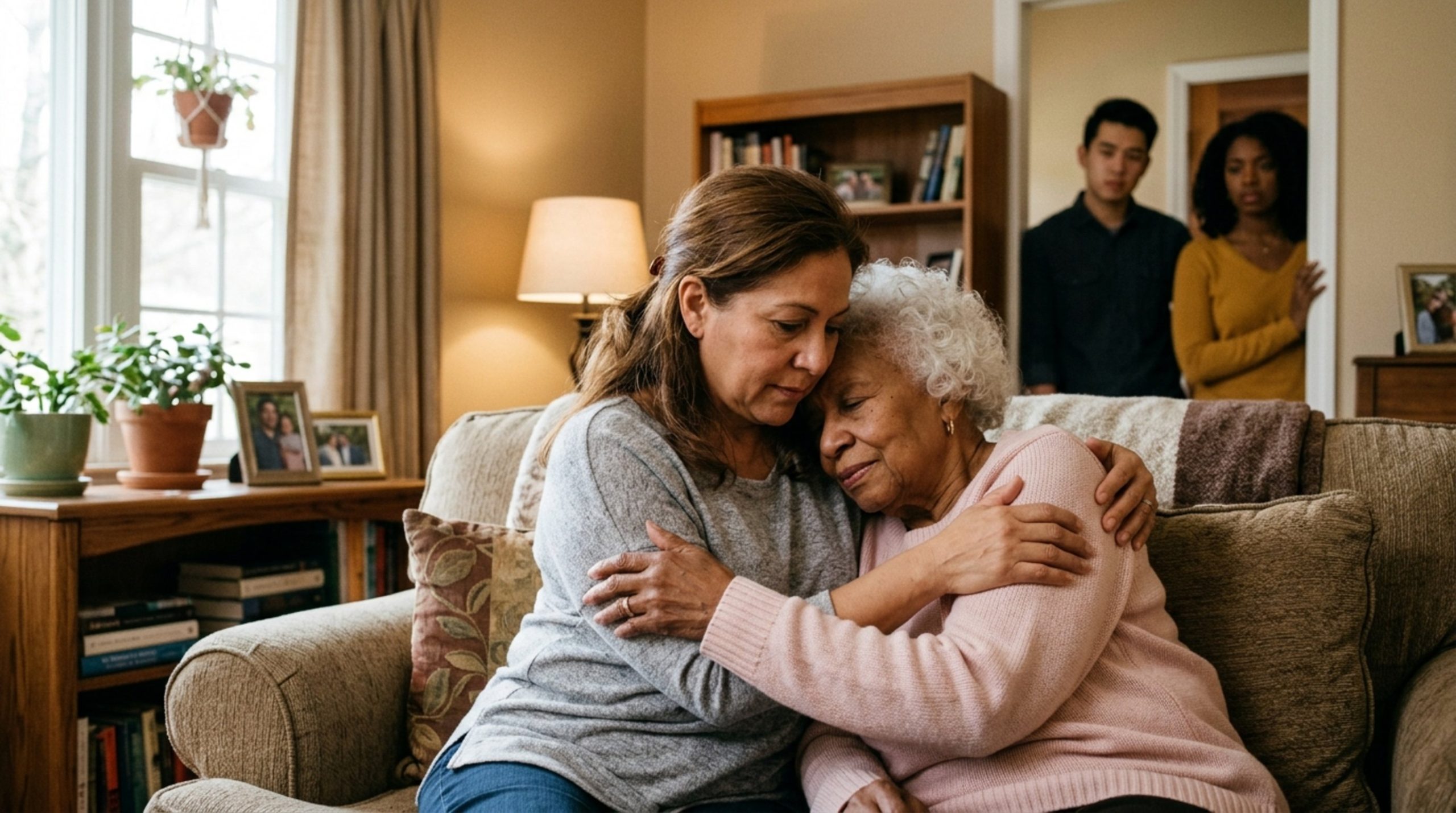
Linda sits wrapped in her familiar blue blanket, her hair neatly brushed, cardigan buttoned with care. A gentle smile rests on her lips, certain she has simply come to see her son. “Michael,” she murmurs softly, “you look tired.”
He swallows hard. “Have you completely lost it?” he hisses. “You can’t bring her here.”
Your hand remains steady on the wheelchair handle. “She’s your mother. Of course I can.”

The mistress—Rachel—finally finds her voice, tight and uneasy. “You said your ex was dramatic. But not… like this.” She gestures awkwardly toward Linda.
Without haste, you unzip the bag and begin placing items on the table one by one: prescription bottles, care supplies, detailed notes, a typed schedule. Each object lands with quiet precision.
“She needs her heart medication every morning,” you explain evenly. “She has to be turned every four hours. Dry food must be softened before she can swallow it safely.”
“Don’t rush her,” you add quietly. “It’s hard for her to swallow.”
Rachel’s complexion drains, not out of compassion but sudden understanding. Michael steps forward, jaw tight. “That’s enough. Take her back.”
“Back where?” you shoot back. “To the house where I handled everything alone while you built a second life here?”
Linda’s faint smile dissolves, replaced by confusion. “Michael… what is she talking about?”
Rachel studies him differently now—truly seeing him for the first time. “You told me she was in proper care.”
“I took care of it,” he mutters.
“No,” you correct, your tone steady as steel. “You avoided it.”
Then you deliver the sentence you prepared long before walking through that door. “This morning I filed for divorce. Adult Protective Services has already received documentation proving you abandoned your disabled mother while spending her pension on this apartment.”
Color vanishes from both their faces.
“What have you done?” Michael snaps.
“I reported the truth,” you reply evenly.
He insists you have nothing to support your claims. Calmly, you list everything: bank transfers, forged signatures, missed medical appointments, text messages where he brushed off her needs as inconveniences. Rachel stares at him in disbelief.
“You used your mother’s money?” she whispers.
Linda lets out a fragile, strained sound. You immediately kneel beside her, your movements gentle and assured. “It’s all right,” you murmur softly. “Michael’s here.”
Michael stiffens. “Don’t call me that.”
You hold his gaze without flinching. “Seven years,” you say quietly. “I’ve earned the right.”
Silence drops heavily between you. Then Linda, her voice unsteady, asks him, “Did you… leave?”
He cannot answer.
She turns her face away from him—and toward you instead.
Later, as you prepare to go, Linda shocks everyone. “Take me… home with you.”
Michael protests, but the moment has already slipped beyond his control. Rachel silently opens the door and murmurs an apology under her breath. You wheel Linda outside, leaving Michael standing in the life he constructed for himself.
That night your phone explodes with messages—threats, accusations, attempts to twist the narrative. You save every single one and forward them to your attorney.
By morning, events move swiftly. Formal inquiries begin. Financial records surface. It becomes clear the house isn’t in Michael’s name at all—it belongs to Linda. With her written consent, legal authority transfers to you.
In court, Michael tries to paint you as unstable. Your lawyer responds with evidence—bank statements, text exchanges, even a voice recording in which he instructs you to use his mother’s funds.
The judge rules without hesitation: custody of your son, Ethan, is awarded to you. Michael is granted supervised visitation only. Responsibility for Linda’s care and finances is placed firmly in your hands.
Gradually, life begins to shift into something steadier.
Without him there, the house feels lighter, as if the walls themselves can breathe again. Ethan sleeps through the night now. Linda softens too; with time, she quietly admits that much of her sharpness over the years came from fear and habit rather than cruelty.
“I was harsh,” she confesses one evening.
“You were,” you answer.
There’s no theatrics in the exchange. Just truth.
Months pass. You rebuild piece by piece—steady work, predictable routines, a sense of safety that no longer feels fragile. Meanwhile, Michael’s world gradually unravels under the weight of his own choices. One day he asks, almost defensively, “Do you hate me?”
You consider it before replying. “No. I outgrew you.”
Later, Linda revises her will, leaving everything to you and Ethan. When she dies quietly at home, Michael arrives too late to say goodbye. At the cemetery, he murmurs only, “I deserved this.”
It’s the first completely honest thing he’s said.
In time, others retell your story as if it were a tale of revenge—a dramatic humiliation, a calculated takedown. But that was never the point.
The truth is far less theatrical.
You didn’t act out of fury. You acted out of clarity. You didn’t hand back a burden—you returned accountability.
It wasn’t anger that drained the color from their faces.
It was evidence.
And in the end, what saved you wasn’t revenge or luck. It was the moment you stopped shielding the man who was destroying your life—and chose instead to protect everyone else.