
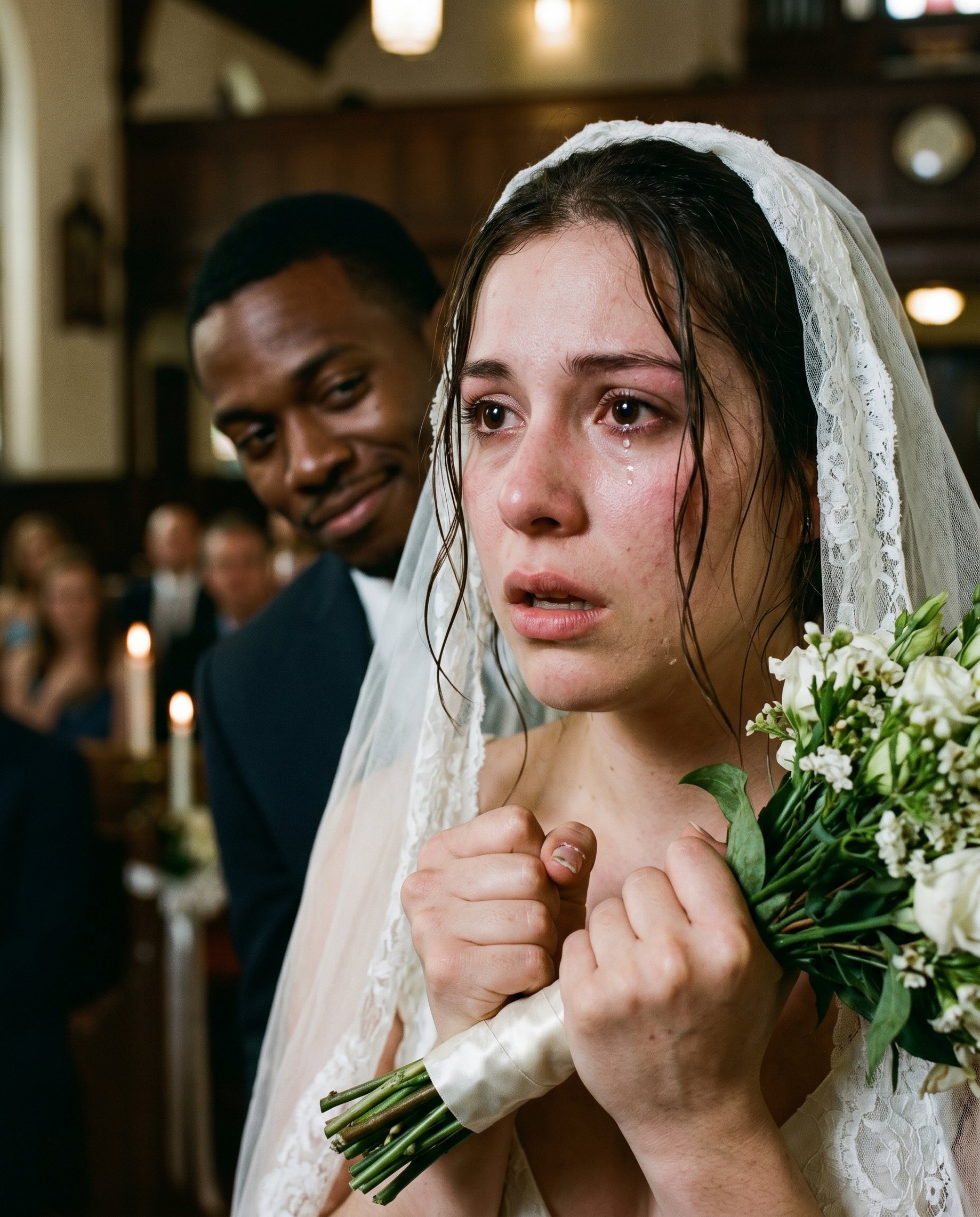
He believed he was humiliating a penniless young woman before God.
In truth, he was destroying himself in front of the only man who controlled what came next in his life.
The chapel had never seemed so silent.
Candle flames shivered along the dark wood paneling. Warm gold light quivered over the bride’s veil. The guests remained stiff in their pews, uneasy long before the groom finally dropped the act he had been wearing.
He pulled the bouquet from her trembling fingers, let his eyes travel over her with icy contempt, and then pushed the flowers back hard against her chest.
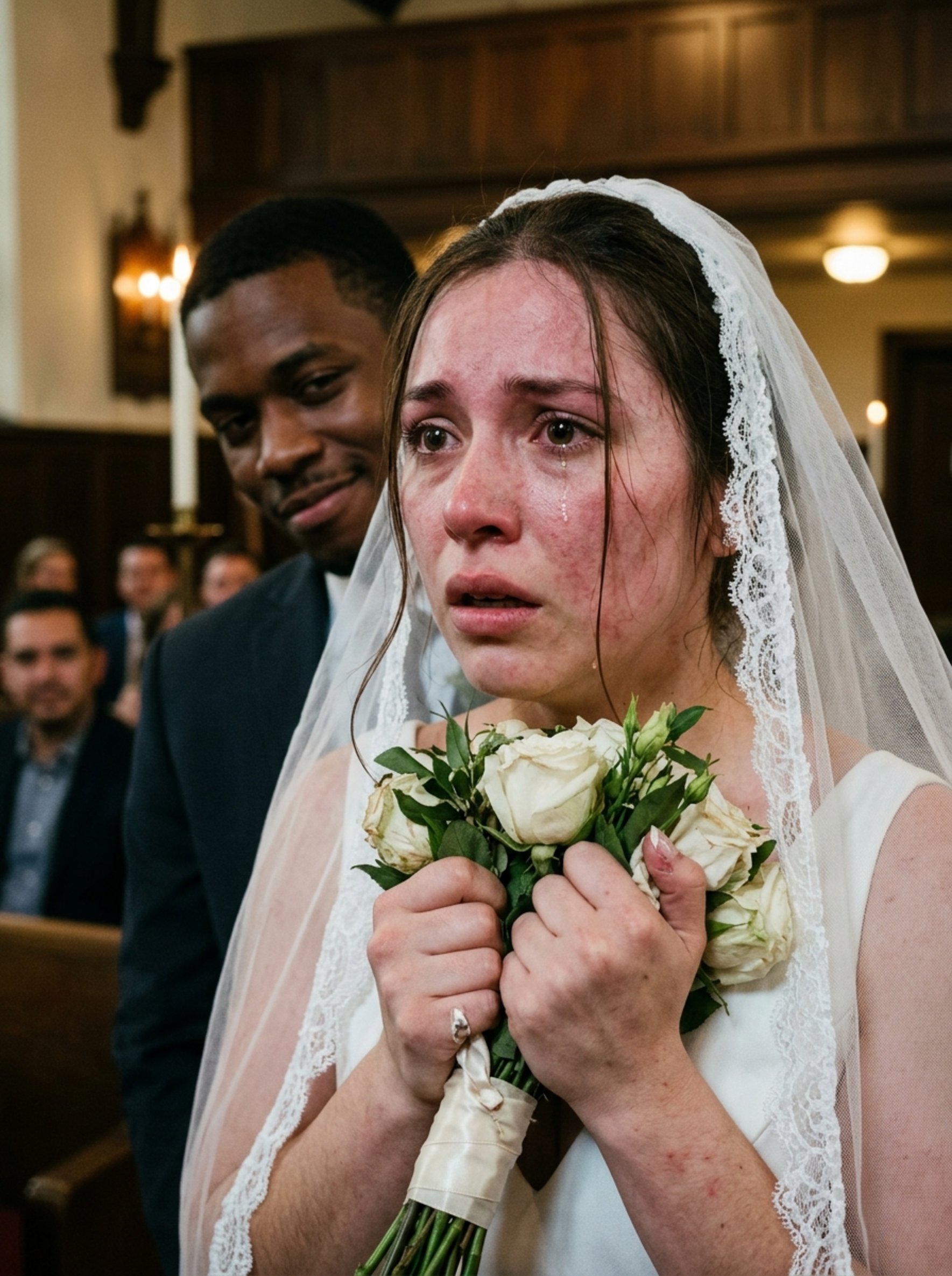
“Did you honestly imagine I would marry someone like you?” he asked, smiling with open cruelty. “A poor girl? I was only using you.”
A shocked breath swept through the church, like dry leaves skittering across stone.
The bride said nothing.
She stood in her white lace gown, clutching the bouquet until her knuckles turned colorless, as though her heart still refused to accept what her ears had just been forced to hear.
Her name was Lily.
For two years, she had loved him with the kind of trust that makes a woman excuse what should never be excused.
The unanswered calls.
The private appointments he would not explain.
The nights when he vanished and returned with explanations that sounded practiced.
The way his expression tightened whenever she spoke about wanting a quiet life, somewhere far from influence, money, and ambition.
Still, she had believed him when he told her he loved her.
She had believed him when he promised that marriage would make everything different.
Now she understood.
It had made everything different only for him.
Because what they had was never love.
It was usefulness.
He had wanted someone obedient, grateful, and easy to manage — a bride without a powerful surname, without wealth, without connections, and without anyone important enough to protect her when he chose to discard her.
He gave a small laugh and looked around at the stunned congregation.
“Seriously,” he said. “Did any of you actually think I’d chain my life to a woman who has absolutely nothing?”
Lily’s tears came faster, but she did not break.
She did not plead with him.
She did not collapse.
She did not scream.
Somehow, that restraint made the scene even more vicious.
Because she no longer looked like a helpless woman being abandoned.
She looked like a person who had realized, far too late, that the man beside her had been a stranger all along.
Then the church doors opened.
Not softly.
Not respectfully.
They burst wide with such force that every head turned at once.
Daylight flooded in, slicing through the dim golden glow of the sanctuary.
And standing inside that brightness was a silver-haired man in a navy three-piece suit, composed as though he had entered a routine meeting rather than a public execution.
He moved down the aisle without rushing.
Before he even reached the altar, the groom’s smug expression began to disappear.
Lily turned toward him, bewildered, tears still shining on her cheeks.
The man stopped at her side and looked at her with a gentleness that felt almost impossible in such a brutal room.
“Forgive me for being late, daughter,” he said. “I was caught in an important meeting.”
Silence followed.
Not a calm silence.
A crushing one.
The groom stared at him as if the floor had vanished beneath his feet.
Because he recognized that face.
Every person employed by the company recognized that face.
Every executive feared it.
This was not merely a wealthy father making a dramatic entrance.
This was Arthur.
Owner of Whitmore Holdings.
The man who had personally approved the merger that could decide whether the groom’s career rose or ended.
The groom opened his mouth, but no words came at first.
Then, with every trace of arrogance stripped from his voice, he stammered:
“Sir… you’re her father?”
Arthur looked at him without the slightest surprise.
“Yes.”
Then his gaze dropped to the bouquet crushed in Lily’s hands.
Beneath the ribbon, something small had been tucked away, folded and nearly hidden.
A document.
Arthur eased it free, opened it once, and became utterly still.
Lily watched the blood drain from his face.
“Dad?” she whispered.
He raised his eyes to the groom with a steadiness more terrifying than any burst of rage.
Then he spoke the sentence that made the groom stagger backward at the altar.
“So you’re the man who forged my daughter’s signature.”
The Girl Everyone Thought Had Nothing
Lily had spent nearly her entire life mastering the art of not being seen.
She was raised in a one-bedroom apartment over a laundromat, where pipes hammered through the winter and passing trucks rattled the windowpanes. Her mother cleaned hotel rooms for a living. Her father disappeared so early that Lily could not remember the sound of his voice.
For a long time, Lily thought poverty showed itself only in visible things — worn shoes, thin coats, plain lunch boxes, and the softer tone adults used with children whose parents wrote checks for school fundraisers.
She was mistaken.
Poverty also lived in the way people expected you to apologize for being too close to comfort that was not meant for you.
So Lily learned to smile quietly.
She learned to work harder than anyone noticed.
She learned to want very little.
She learned not to explain herself unless she absolutely had to.
By the time she was twenty-three, she had become a junior administrative assistant at Whitmore Holdings, an enormous private investment firm where people wore watches worth more than her mother’s annual rent and discussed layoffs with polished phrases like “operational efficiency.”
She did not fit there.
At least, that was what everyone seemed to believe.
Her desk sat near the copy room.
Her badge allowed her onto three floors, but it earned her no respect.
Executives passed by without bothering to learn her name.
Assistants from wealthy families called her “sweetie.”
Men in expensive suits asked her to print files they could easily have printed themselves.
Lily did the job.
Quietly.
Precisely.
And she watched.
That was her strength.
People tend to underestimate quiet women.
Lily used that to survive.
She noticed which executives lied during phone calls.
She saw which signatures returned too quickly.
She caught the differences between the first drafts of merger paperwork and the final versions.
She noticed which junior analyst looked pale with fear after meeting Jason.
Jason.
The man now standing at the altar.
The man she had once believed loved her.
In the beginning, he had been charming.
Not loudly charming.
That kind of charm would have warned her.
Jason was gentle in his speech, attentive in his habits, and ambitious in a way that seemed romantic when he aimed that attention at her.
He brought her coffee.
He remembered her birthday.
He walked her to the train whenever she stayed late.
He told her she was the only honest person in the entire building.
That should have been the first warning.
Manipulators often begin by convincing you that your goodness makes you exceptional.
Jason said he despised the arrogance of the people above him.
He said he wanted to build his success honorably.
He said he admired Lily because she cared more about human beings than money.
She believed him.
Then, one night after a long shift, he kissed her outside the elevators.
For the first six months, they kept their relationship hidden because Jason said office gossip could damage both of them.
For another year after that, Lily persuaded herself that secrecy was a form of protection.
He met her mother.
He brought flowers.
He called her mother “Mrs. Carter.”
He fixed the old kitchen sink.
He sat at their small table eating soup as if there was nowhere else on earth he would rather be.
Her mother did not trust him.
At the time, Lily hated her for it.
“He looks at the room before he looks at you,” her mother told her.
“What is that supposed to mean?”
“It means he’s calculating what he can take.”
Lily cried that night because she thought her mother was judging Jason for wanting more from life.
She understood the truth far too late.
Jason proposed in the park at sunset.
There was no photographer hiding nearby.
No crowd.
Only a ring, a nervous smile, and the words Lily had waited her whole life to hear.
“I choose you.”
She said yes.
Three weeks later, he asked for a favor.
A small favor.
That was how he described it.
Just an ordinary document.
A witness acknowledgment.
Something connected to internal processing for the Meridian acquisition.
“I can’t send this through senior administration without creating pointless delays,” he explained. “You know how corporate procedures are.”
Lily frowned.
“I’m not authorized to approve merger documents.”
“You aren’t approving anything,” he said. “It’s only a routing confirmation.”
She hesitated.
He kissed her forehead.
“Lily, I would never put you in danger.”
That should have stopped her.
Instead, it comforted her.
She signed where he told her to sign.
Or at least, that was what she believed.
A week later, she found her signature on a document she had never seen before.
It was a consent release connected to restricted shareholder assets.
The name printed at the top made her stomach turn cold.
Lily.
But beneath it, in smaller letters, appeared another name.
Lily.
She had never used that name.
Because she had never known it belonged to her.
When Lily confronted Jason, his smile came too slowly.
“Where did you find that?”
“What is this?” she demanded.
“Nothing you need to worry about.”
“My name is on it.”
“It’s paperwork.”
“Why does it say Whitmore?”
Something shifted in his face.
Only a little.
Then he touched her cheek.
“Baby, the wedding is making you anxious.”
She stepped away from him.
That was the first moment she became truly afraid of Jason.
Not because he raised his voice.
Because he did not.
The following day, the document vanished from the system.
Her access logs had been erased.
Jason told her she must have misunderstood what she saw.
Then he became flawless again.
Kind.
Gentle.
Remorseful.
He said the pressure of the wedding had made both of them emotional.
Lily wanted desperately to believe him.
Sometimes love is not blindness so much as exhaustion.
She was tired of doubting everything.
Tired of feeling poor in rooms filled with confident liars.
Tired of wondering whether her suspicion came from fear rather than truth, because maybe she had never learned how to be loved without bracing for pain.
So she kept moving toward the wedding.
But she made one decision Jason knew nothing about.
She printed the document.
Folded it carefully.
And pinned it beneath the ribbon wrapped around her bouquet.
She did not fully understand why.
Maybe instinct guided her.
Maybe fear did.
Maybe some small, buried part of her already knew that even an altar might not be sacred enough to stop him.
The Father She Was Told Had Left Her Behind
Arthur had known Lily existed for exactly nineteen days.
For the twenty-four years before that, he had believed his daughter was dead.
Not Lily.
Her mother.
Clara.
Arthur’s only child.
Clara had been twenty-two when she fell in love with a mechanic named Samuel. Arthur despised the match. Not because Samuel was violent. Not because he was idle. Not because he treated her badly.
The real reason was Samuel’s place in the world.