
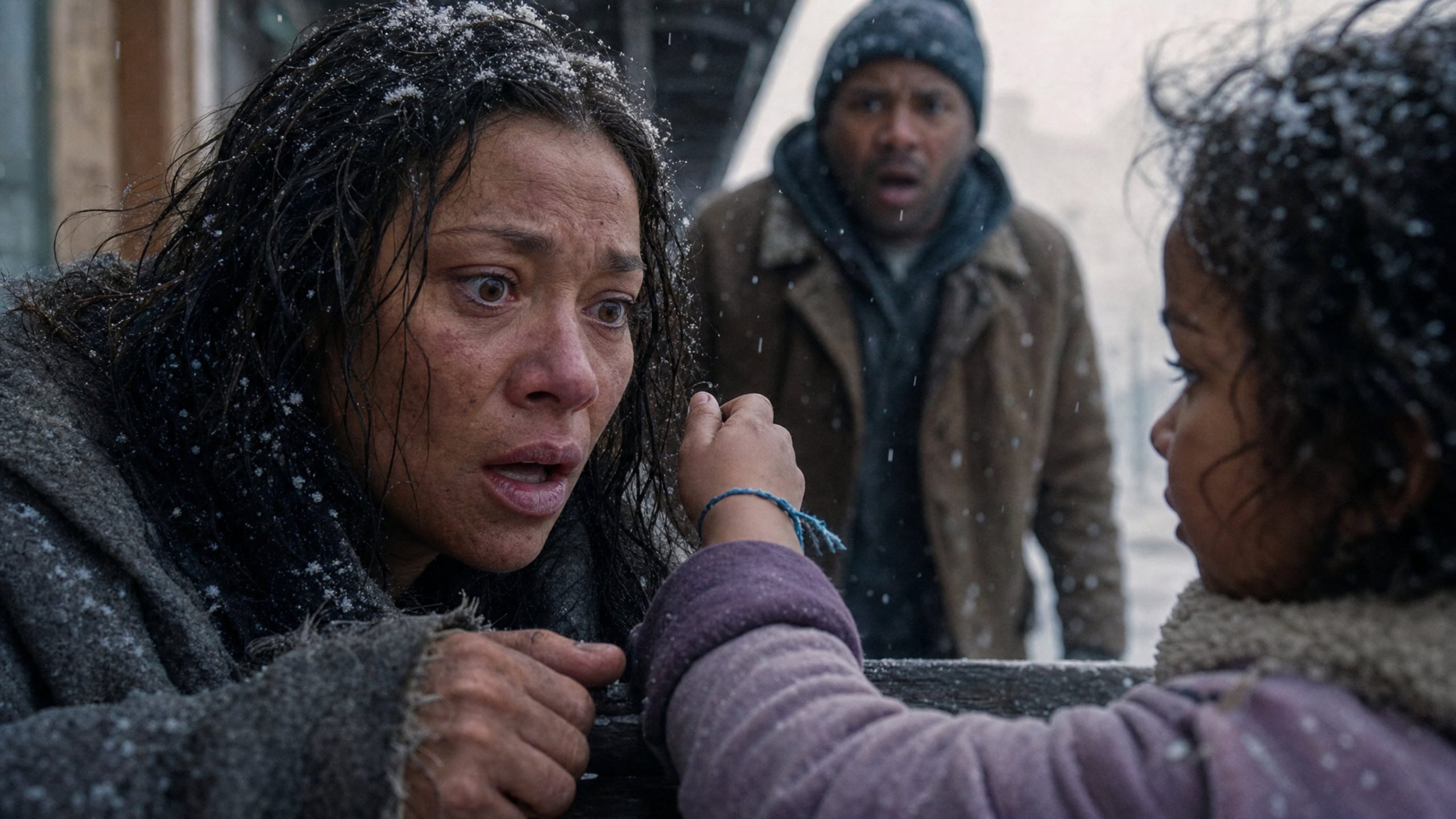
“Catherine.”
Michael rose from his chair as if every joint had to remember how to move.
Only then did Emily truly see what sorrow had carved into him.
It had not hollowed him out.
It had not made him fragile.
It had made him deliberate.
Painfully deliberate.
The sort of deliberate a man became when he had learned to measure every step—until the moment truth stepped in and made caution turn sharp.
“My mother told you that?” he asked.
Grace gave a small nod.
“She said Mommy got sick because she didn’t love me the right way.”
Emily recoiled as though the words had physically struck her.
Michael turned his face toward the street and dragged in a breath that did not steady him.
“Emily, I swear to you,” he said, his voice rough, “I didn’t know.”
And she believed him.
Not because believing him was easy.
Not because some desperate part of her wanted to.
She believed him because the anguish on his face was too raw to have been practiced.
He shrugged out of his coat and placed it around her shoulders.
Emily tried to push it back.
Michael ignored the protest, but gently, as if even helping her required permission from the air around her.
“You’re freezing,” he said. “We need to get you somewhere warm.”
“No hospitals.”
The answer tore out of her too quickly.
Too frightened.
Michael heard the panic inside it.
“No hospitals,” he said at once. “I promise.”
Promises were dangerous things.
Emily knew that better than most.
Still, his voice found a buried place inside her, a place that remembered the man he had been before everything had been shattered and rearranged by other people’s hands.
“There’s a diner just around the corner,” he said. “We’ll go in. You’ll eat something. Warm up. After that, I’ll contact someone I trust.”
Emily looked at Grace.
The little girl stepped closer, then bent to pick up the paper bag that had fallen into the snow.
One pastry had slid out and was ruined.
The rest remained folded inside their wrappers.
Grace offered the bag again with solemn determination.
“You can still have these.”
Emily stared at the child.
Her child.
The words shone too brightly inside her, almost painful to look at straight on.
She accepted the bag with both hands.
“Thank you,” she whispered.
Grace nodded, grave and polite.
“You’re welcome.”
They made their way toward the diner with Michael walking on one side of Emily and Grace on the other.
Emily’s legs trembled so violently that Michael kept his hand close to her elbow, never quite touching unless she faltered.
At the corner, Grace’s mittened fingers slipped into Emily’s hand.
Emily nearly stopped in the middle of the sidewalk.
She looked down.
Grace did not glance up.
She simply held on.
When they stepped inside the diner, heat rushed over Emily’s face so abruptly that tears sprang to her eyes. The waitress behind the counter took in Emily’s bare feet, then Michael’s expression, and after half a heartbeat, chose compassion instead of questions.
“Back booth,” she said softly. “I’ll get some towels.”
Michael ordered soup, coffee, pancakes for Grace, and tea for Emily, because he remembered that she had never been able to stand coffee unless it was drowned in milk.
That small memory hurt in a way she had not expected.
While Grace bent over a children’s menu and colored with a red crayon, Michael took out his phone.
Emily’s eyes snapped to it.
“Who are you calling?”
“My attorney.”
Fear went through her like a blade.
“No.”
“He isn’t one of them.”
“No lawyers.”
“Emily—”
“They used papers,” she said.
Michael stopped.
He lowered the phone slowly.
Her breathing had grown fast and shallow.
He set the device facedown on the table.
“All right,” he said. “No call. Not yet.”
Grace looked from one adult to the other, then down at Emily’s hands.
“You’re shaking.”
“I’m fine.”
“That’s what people say when they’re really cold.”
For the first time, Emily almost smiled.
Michael glanced toward the diner window.
His jaw tightened.
Emily followed his stare.
Across the street, a black SUV sat idling beside the curb.
Dark windows.
Motionless.
Far too still.
Michael got to his feet.
Grace’s crayon paused above the paper.
Emily whispered, “What’s wrong?”
The rear window of the SUV slid down halfway.
A woman’s face appeared in the gap.
Elegant.
Silver-haired.
Known.
Catherine Hale.
Michael’s mother.
She looked straight at Emily.
And there was no shock in her expression. No horror. No disbelief at the sight of a dead woman standing in the snow.
Catherine smiled.
Then she raised her phone to her ear.
The Woman Who Smiled at Ghosts
Michael was the first to move.
He reached toward Grace.
Emily caught his wrist.
“No.”
His eyes remained locked on the SUV.
“She saw you.”
“I know.”
“She recognized you.”
“I know.”
“She wasn’t surprised.”
That was the worst part.
That was what made the warm diner suddenly feel colder than the sidewalk outside.
Catherine Hale had not looked at Emily as if she were a ghost. She had not looked at her as if she were a miracle or a nightmare brought back from the grave.
She had looked at her like a problem she had always known might return.
Before Michael could make it to the door, the SUV rolled away from the curb.
He stood outside in the falling snow, watching it turn the corner, his hands clenched at his sides.
When he came back to the booth, something in his face had altered.
The careful grief was gone.
In its place was something Emily had never seen in him before.
A declaration of war.
Grace’s voice came out small.
“Is Grandma angry?”
Michael sat down beside her and took her hand.
“Grandma has some explaining to do.”
“She doesn’t like explaining.”
“I know.”
Emily wrapped both hands around the mug of tea.
“What happened after they told you I was dead?”
Michael looked at Grace first, then back at Emily.
“We don’t have to talk about that right now.”
“Yes,” Emily said.
Her own firmness startled him.
It startled her too.
“I need to understand what they did.”
Michael let out a long breath.
“At the clinic, after you delivered, everything turned chaotic. They told me you were hemorrhaging. They said they had to take you into surgery. My mother arrived. Then your mother came too. I don’t even remember who called them.”
“My mother wouldn’t come when I begged her to,” Emily said.
“I know. That was why it confused me.”
Michael rubbed both hands over his face.
“They kept me in a waiting room for hours. Catherine kept telling me I had to think about the baby. She said you had been unstable during labor. She said the doctors had warned her about possible postpartum episodes.”
Emily stared at him.
“No doctor warned her about anything.”
“I know that now.”
“Did you know it then?”
Shame filled his eyes.
“I was twenty-seven,” he said quietly. “I was terrified. My newborn daughter was behind glass, and nurses were telling me you might not survive. My mother sounded absolutely certain. Your mother looked destroyed. I believed the room because every person in it was saying the same thing.”
The sentence settled into Emily without making a sound.
I believed the room.
She understood that too well.
Rooms had power.
Hospitals.
Police stations.
Courtrooms.
Clinics.
When everyone in a room agrees to a lie, truth begins to sound like madness.
Michael went on.
“They let me see a body.”
Emily’s breath stopped.
“What?”
“It was covered. Only for a moment. Your mother told me it would be kinder if I didn’t remember you that way. Catherine said I needed closure.”
His voice cracked.
“I saw hair like yours. Your bracelet. A hand. I thought it was you.”
Emily felt bile rise in her throat.
Someone else.
A dead woman turned into a curtain.
“Did you bury her?”
“Cremation,” he said. “They pushed it through quickly. Your mother said it was what you would have wanted.”
Emily slowly shook her head.
“No.”
“I didn’t know.”
“No.”
“I should have.”
She looked at him.
He was waiting for her anger.
She had anger. More than enough.
But not for that.
Not yet.
“They built a room around you,” she said. “The same way they built one around me.”
Michael looked at her then.
Really looked.
And for the first time, their grief touched without becoming accusation.
Grace leaned against Michael’s side, the blue thread bracelet bright against the yellow of her sleeve.
“Daddy?”
“Yes, sweetheart?”
“Is Mommy coming home?”
Emily flinched.
So did Michael.
The question was innocent.
It was also impossible.
Emily looked down at her hands.
Cracked.
Filthy.
Thin.
Hands that had slept under bridges and wrapped themselves around paper cups of soup in shelter lines.
Home.
She could barely remember the shape of that word in her mouth.
Michael answered with care.
“First, we’re going to make sure she’s safe.”
Grace accepted that with a nod.
Then she nudged her plate of pancakes toward Emily.
“You can have some of mine.”
Emily almost broke open all over again.
The diner door swung inward.
A man in a long charcoal coat stepped inside, brushing snow from his shoulders. He was Black, in his sixties, with a carefully trimmed beard and calm eyes that suggested he had spent a lifetime listening to lies and waiting for them to collapse.
Michael stood.
“Robert.”
The man’s gaze moved to Emily.
His expression did not change much, but something in it softened.
“Emily,” he said.
She stiffened.
“How do you know who I am?”
“My name is Robert. Michael hired me as his attorney after your death.”
Emily’s fingers tightened around the edge of the booth.
Michael turned on him sharply.
“You told me there was nothing more we could do.”
Robert gave one slow nod.
“And I was wrong.”
The admission landed with weight.
He did not sit until Emily gave him the smallest nod of permission.
“I reviewed your medical records six years ago,” Robert said. “On paper, they were immaculate. Too immaculate. I requested the surgical notes. The clinic claimed they were sealed. I filed a petition once. It disappeared. Then Michael’s mother told him that pursuing it would harm Grace.”
Michael’s face hardened.
“She told me it would keep Emily from resting.”
Robert looked at him.
“She told me you wanted the matter dropped.”
Michael went completely still.
There it was.
The design.
Not one lie.
A network of them.
Different versions given to different people, each lie built to make the next person’s silence look like a choice.
Robert opened a leather folder and removed several documents.
“I kept copies of everything I was able to obtain. There were inconsistencies. No death certificate was filed through the county hospital system. A private cremation authorization was signed by Linda Whitfield.”
“My mother,” Emily breathed.
“Yes.”
Emily closed her eyes.
Her mother had always been difficult.
Proud.
Sharp-edged.
Bitter that Emily had chosen Michael instead of the nursing career Linda had planned for her.
But this?
Robert continued.
“There was also a psychiatric transfer form.”
Emily opened her eyes again.
“Transfer to where?”
“Meridian Women’s Recovery Center.”
Her stomach lurched.
That name.
The locked room.
The woman with the clipboard.
The place Angela had helped her escape from.
Michael saw the change in her face.
“You know it.”
“I was there.”
All color drained from him.
Robert’s pen stilled above the paper.
“You were held at Meridian?”
Emily nodded.
“For three weeks. Maybe longer. They told me I had tried to hurt Grace.”
Michael shot to his feet so abruptly the table rattled.
Grace startled.
He sat back down immediately and pulled her close.
When he spoke, his voice was almost frightening in its softness.
“My mother sits on Meridian’s donor board.”
Emily’s hands went cold.
The booth seemed to close in around them.
Robert shut the folder.
“Then we handle this carefully and immediately. Emily, I know you have every reason not to trust legal systems. But now that Catherine has seen you, she will act fast. We need protection, documentation, and an independent medical evaluation before anyone tries to brand you unstable again.”
Emily turned toward the window.
Snow blurred the street beyond the glass.
Somewhere out there, Catherine was already making calls.
Maybe Linda too.
Maybe Meridian.
Maybe the police.
Maybe people Emily had never even known existed.
“I don’t have papers,” Emily said.
“I understand.”
“I don’t have proof.”
Grace lifted her wrist.
“You have the bracelet.”
Emily looked at her daughter.
The child said it so simply.
As though a loop of blue thread could stand against wealth, signatures, locked wards, and six years of carefully maintained lies.
Robert’s gaze shifted to the bracelet.
“Actually,” he said after a moment, “she may be right.”
Michael looked at him.
Robert leaned forward.
“If that bracelet was recorded as being on the alleged body, and Grace has had it all these years, then one of two things is true. Either the body was misidentified, or someone used Emily’s belongings to stage the identification.”
Emily touched the blue thread with trembling fingers.
Michael whispered, “My mother gave it to me after the cremation.”
Robert’s eyes sharpened.
“Then she handled evidence.”
Before anyone could answer, the television mounted above the counter switched from a local weather segment to breaking news.
A reporter stood outside the train station.
Emily recognized the bench behind her.
Her bench.
The headline beneath the reporter read:
UNSTABLE HOMELESS WOMAN APPROACHES CHILD NEAR WESTBROOK STATION
Emily forgot how to breathe.
The image changed.
A grainy photo filled the screen.
Emily, wrapped in Michael’s coat, holding Grace’s hand.
The caption below it read:
POLICE SEEK PUBLIC’S HELP IDENTIFYING WOMAN
Grace looked up at her father.
“Daddy?”
Michael’s face had gone white with fury.
Robert whispered, “She moved even faster than I thought she would.”
Emily stared at the television while the report continued.
The reporter explained that a concerned family member had reported a disturbing encounter involving a child and a woman believed to be suffering from untreated mental illness.
A tip line number appeared on the screen.
Then they showed Catherine Hale.
Standing beside her black SUV.
Silver hair smooth.
Posture composed.
Voice trembling with flawless precision.
“We only want to protect our granddaughter,” she said.
Emily rose from the booth.
The diner seemed to tilt under her.
Michael reached for her.
“Emily—”
But she pulled away as panic swallowed every clear thought she had left.
“They’re doing it again.”
The Story They Tried to Tell Twice
Emily ran.
Not far.
Only to the diner bathroom, where she locked the door behind her and slid down to the floor beside the sink.