

The Day He Came Home Early
Graham had never put much faith in surprises—least of all in the carefully regulated machinery of his own life. At fifty-six, he had built everything around precision. His calendar ran down to the minute, his habits never drifted, and his estate near Charlottesville remained in a state of flawless order.
Even the garden behind the house seemed less like a living patch of earth than a deliberately arranged display. Every shrub, stem, and bed stood in exact formation, as though discipline itself had taken root in the soil.
That Thursday, he was not supposed to return during the day. A meeting ended ahead of schedule, and his driver brought him back earlier than planned. When Graham stepped out of the car, he expected the familiar calm that came from control and routine. Instead, something entirely different reached him.
Laughter.
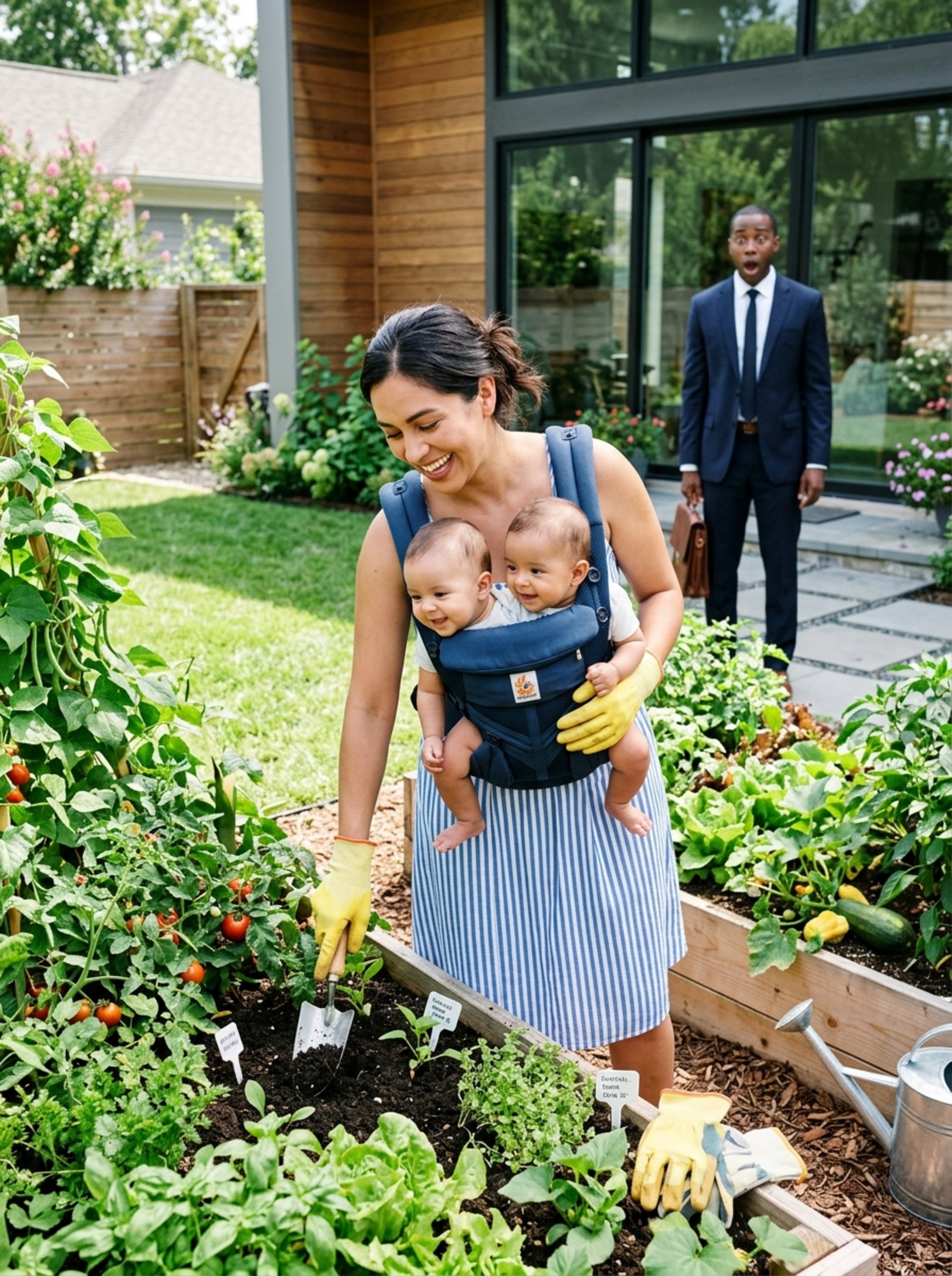
Small, bright, ringing laughter—unmistakably the sound of children.
His expression tightened at once, and he followed the noise toward the garden. There, among the perfectly maintained rows, Ivy was kneeling in the dirt—his quiet, capable housekeeper. But she was not alone.
Two infants were strapped to her, one against her chest and the other on her back, while she worked the soil with both hands. Her clothing was stained, her hair damp from effort, and the babies stretched toward the world around them, giggling as if the garden had been made for their delight.
For several seconds, Graham simply stared. Then anger took hold of him.
“What is going on here?”
Ivy flinched, terror flooding her face. The babies sensed it instantly and began to cry.
Ivy tried to speak.
She struggled to explain herself: the childcare she had counted on had fallen through without warning, she could not afford to miss a day’s work, and there had been no one else to take the children. But Graham heard only disorder. He heard rules being broken—rules he had spent a lifetime enforcing without exception.
“Take them and leave,” he said, his voice flat and cold. “You’re finished here.”
Her soft plea followed him as he turned away, but he did not look back.
That evening, the house remained exactly as it always was: silent, spotless, composed, every surface in its proper place. And yet something about it felt wrong. From the window, Graham watched Ivy make her way down the long driveway, burdened with bags, a child in each arm, facing the road alone.
By nightfall, he was forced to admit the truth he had been trying to avoid. Peace had not returned. The quiet felt hollow.
The next morning, he did something entirely unlike himself. He went looking for her.
Her apartment on Mercer Street was small and worn around the edges, but it had been kept with care. Nothing there spoke of comfort or abundance; everything spoke of effort. Laundry hung to dry indoors, baby bottles stood neatly in a row, and two cribs had been placed side by side. It was not a mess. It was survival.
When Ivy told him the rest—the absent father, the days without help, the crushing costs she could barely meet—Graham listened. Not politely. Not impatiently. Truly listened.
“I wasn’t trying to disrespect your home,” she said in a low voice. “I was only trying to get through the day.”
For the first time, Graham understood there was a difference between order and compassion.
And he saw, with uncomfortable clarity, which side he had been choosing until then.
When Graham returned to the estate, he walked the grounds as if he were seeing them for the first time. The garden no longer looked merely maintained. He noticed the care Ivy had left everywhere—the small thoughtful touches, the practical choices that blended into the landscape, the quiet naturalness that reminded him of the garden his mother had once loved.
Something inside him shifted.
The following morning, he gave one plain instruction: hire a full-time nanny.
A few days later, Ivy came back expecting nothing more than paperwork. Instead, Graham met her with something she had not prepared herself to hear—an apology.
“I judged you too quickly,” he told her. “I was wrong.”
Then he offered her position back, this time with better pay and guaranteed childcare.
Ivy did not collapse into gratitude. At first, she stared at him with guarded disbelief, as if kindness might still turn into a trick. But when the truth of it settled in, the tension in her shoulders gave way, softening into a tired, quiet relief.
“Thank you,” she whispered.
Before long, the house began to change. Not into disorder, but into something warmer. Silence gave room to laughter. Small evidence of life appeared in unexpected corners—baby blankets, soft little sounds, sudden bursts of joy.
Graham had assumed it would irritate him.
It didn’t.
If anything, he found himself drawn toward it. He learned the twins’ names—Nora and Eli—their tiny habits, their laughter, the trusting way they reached for familiar hands. And Ivy was no longer merely someone on his payroll. He began to see her as a person: bright, resilient, quietly powerful.
With time, respect deepened into something he had not expected.
One evening, as they stood near the fireplace, Ivy finally asked him why.
“Why are you helping us?”
“In the beginning?” Graham said, the confession coming quietly. “Because I felt guilty. Later, because I respected you. And now… because you matter to me.”
Ivy did not answer right away. Still, something in her eyes eased, as if a guarded door had opened a little.
By spring, the estate no longer resembled a polished exhibit of flawless order. It had a pulse. Nora and Eli chased one another through the garden. The staff learned to bend with the new rhythm. And Graham, who had once prized control above nearly everything else, discovered something far richer: connection.
Walking beside Ivy among the tender green shoots, he put the truth into plain words.
“I used to believe control was the same as safety. I was wrong. You changed this house. You changed me, too.”
Then, with a sincerity made careful by how much it cost him to say it, he added, “I love you. I want a life that has room for you—and for your children.”
Tears gathered in Ivy’s eyes before a small smile broke through.
“That took you long enough,” she murmured.
“I know.”
She slipped her hand into his.
Only then did Graham truly understand, for the first time, that the best things in life cannot be built by control alone. They have to be tended, chosen again and again, and allowed the space to grow.
Behind them, the garden stirred gently in the spring wind. It was no longer perfect. At last, it was alive.
Final thought
A life constructed only around control may appear immaculate, yet it often lacks warmth. Real transformation begins when judgment gives way to understanding, and certainty is softened by compassion. Sometimes the very thing that disturbs our order is the thing that teaches us how to live.