
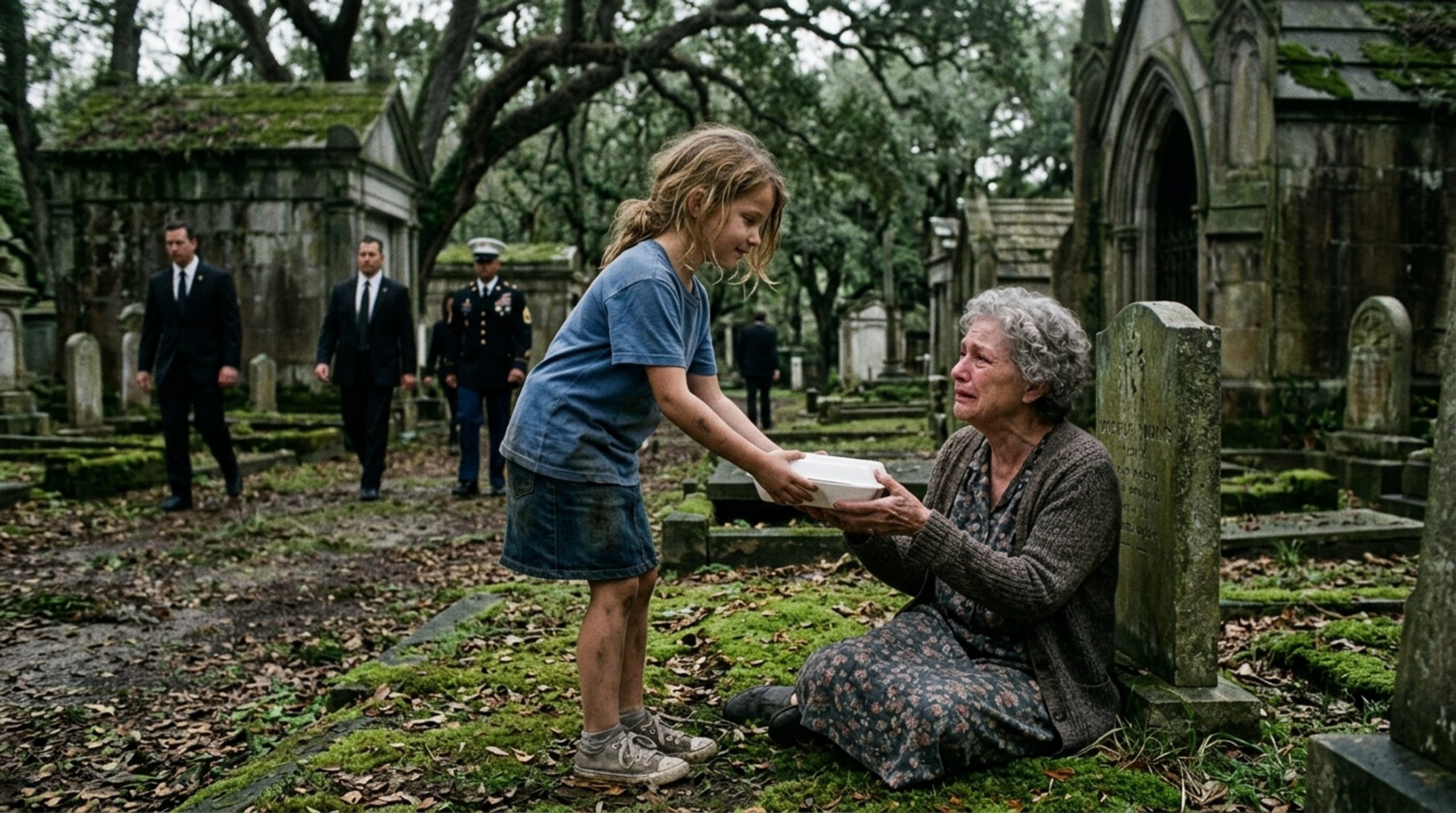
sat Linda.
Her white hair was pinned into a tight bun, and on her feet were worn-out sandals. She wore a faded wool sweater that smelled faintly of cheap soap, and her eyes had the drained, hollow look of someone who had cried until there was almost nothing left. Every day she came to speak to the man buried there: Michael, the husband who had shared forty-two years of her life, and who had been gone for nearly a year now.
At first, Emily only watched from a distance. She had learned that grown-ups could be dangerous, even the ones who looked brokenhearted. But one afternoon, pushed forward by a courage she could not quite explain, she walked over with the foam container in her hands and asked, as if offering a small piece of sunlight:
“Are you hungry?”
Linda lifted her face. She noticed the filthy clothes, the scraped knees, the borrowed sandals. But what she truly saw was something else.
Loneliness.
The kind that made no sound at all, yet pressed down on a person like a stone.
“And what about you, sweetheart?” Linda asked softly. “Aren’t you going to eat?”
Emily gave a small shrug, as though the answer should have been obvious.
“We’ll split it.”
And that was exactly what they did. Emily opened the container, carefully moved half the rice, beans, and chicken onto the lid, and handed it to Linda. They ate side by side without speaking, while the evening breeze moved in whispers between the graves.
There were no questions.
No explanations.
Only food.
When they were done, Emily smiled a little, almost shyly.
“I’ll come back tomorrow.”
And she did.
The next day.
And the day after that.
And the one after that, too.
Slowly, the silence between them softened into conversation.
Linda told her about Michael—how he had worked construction, how he used to whistle while he worked, and how he always came home dusty and smiling, with his arms ready to hold her. They had never been wealthy, she said. They counted every penny. Sometimes the rent was late. But somehow, whenever she was sad, Michael always found a way to bring her a flower.
“He was my whole world,” Linda whispered. “And now that he’s gone… I don’t know why I’m still here.”
Emily listened with a seriousness that did not belong to a child, but to someone who had seen too much far too early. Sometimes she reached for Linda’s hand. Other times she simply sat beside her in silence, understanding without being told that some kinds of pain did not need words.
And little by little, almost without realizing it, Linda began to watch Emily more closely, too.
Emily told her about her mother, Sarah—how she had fallen ill all at once.