
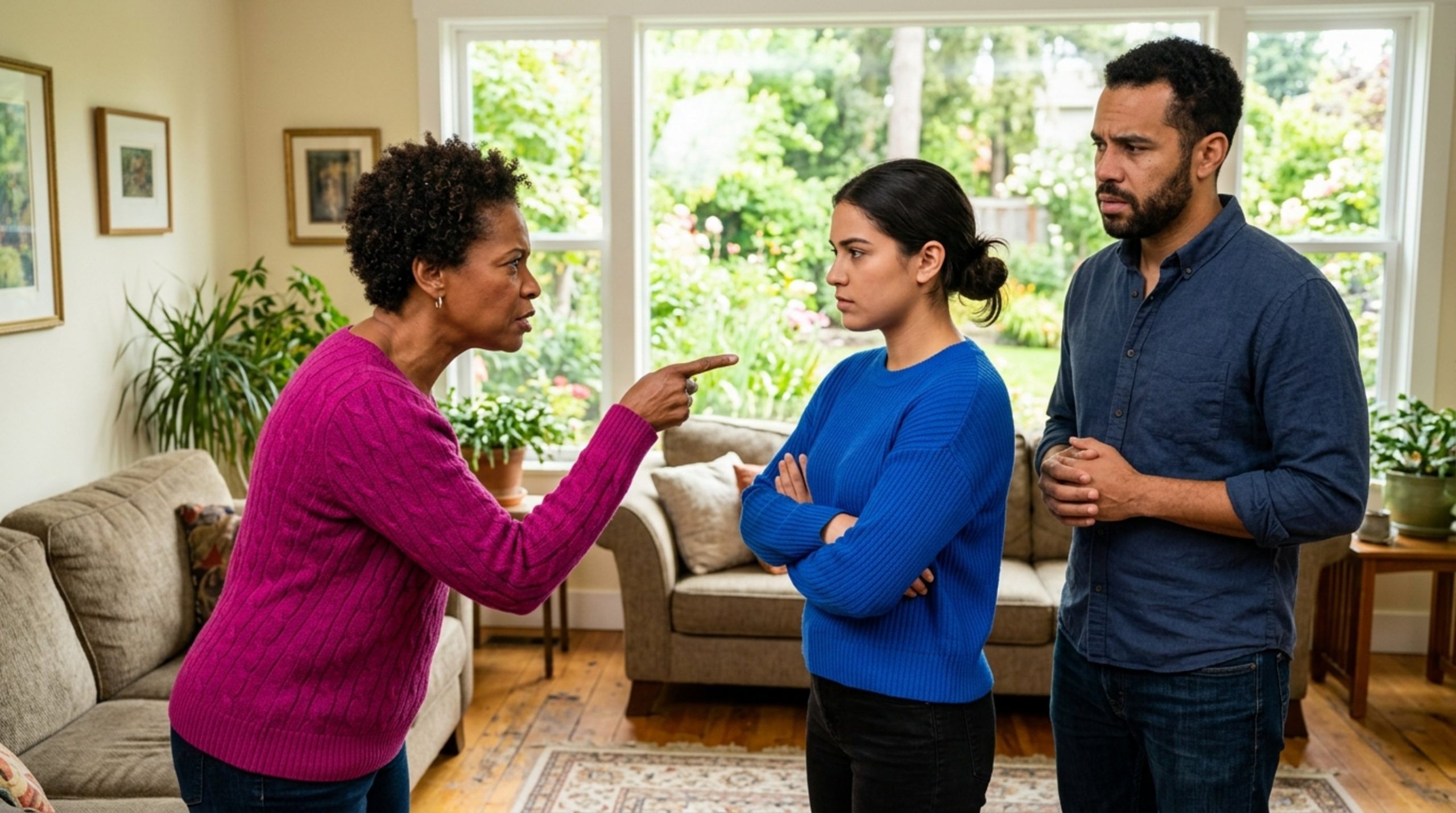
“A little house?” Emily repeated, her voice level. “Then there’s nothing for us to discuss. If that’s all it is to you, find another one.”
“Jessica had already talked to the children, you know. They thought they were going to spend the summer out in the fresh air.”
“Then you shouldn’t have given them false hope.”
“Have you no shame?”
“No,” Emily said. “Do you?”
For a moment, the line went silent. Then Linda slipped back into her usual manner: pressing, wounded, accusing.
“You were always greedy about what was yours. Everything is ‘mine, mine, mine’ with you. That is no way to build a family.”
“And taking what belongs to someone else is no way to build one either,” Emily replied, and ended the call.
A week later, Michael sent her a message: “Let’s talk calmly.”
She agreed, but not at home. They met in a small café near the market. Emily arrived first and chose a table by the window. Michael sat across from her, turning a spoon between his fingers for a long time before he finally spoke.
“Mom went too far. I admit that.”
“Go on.”
“But you didn’t have to act so harshly either.”
“Go on.”
He let out an irritated breath.
“What else do you want me to say? I came here to make peace.”
“Making peace means a person understands what he did. Do you?”
“I just said she went too far.”
“Not she. You. You gave your mother permission to show my house. You kept quiet while she acted like she owned it. And afterward you were angry because I changed the locks.”
Michael looked away.
“I thought you’d come around eventually.”
“Exactly,” Emily said. “You weren’t planning to ask me. You were planning to wear me down.”
He had no answer. He picked up the menu as if some perfect phrase might be hiding between the lunch specials, then put it back on the table.
“So that’s it?” he asked.
“That’s it.”
“Because of a principle?”
“Because there is no respect.”
There was nothing left to say after that. Emily stood first, put on her coat, and walked out. Michael did not run after her. He did not grab her hand, did not try to explain himself beautifully in the doorway, did not suddenly become the man who would fight for her. And that, too, was an answer. A person accustomed to letting his mother and circumstances decide everything for him did not know how to defend anything or hold on to anyone. He only knew how to feel offended when convenience was taken away.
The divorce did not happen quickly. Emily and Michael had no children, and there was no shared property to divide, but there was no agreement left between them either. Emily filed through the court because going together to sign papers and pretending it was a mutual, peaceful decision would have been a lie. At first Michael made threats. Then he quieted down. Linda was probably still offering advice from the sidelines, but the old force had gone out of her. After that scene in the village, Emily never again heard that confident tone from her mother-in-law. There were only sharp little comments passed through acquaintances and rare attempts to make it sound as if the daughter-in-law had simply “turned out to be difficult.”
Emily met the summer in the village alone. Strangely enough, for the first time in a long while, she felt truly calm. She woke early, opened the windows, let the chickens out, walked barefoot across the warm boards of the porch, and felt not emptiness but relief. On weekends, Katie came to visit. Sometimes Carol stopped by with a jar of sour cream or a bit of neighborhood news. The house breathed its own quiet life. It smelled of new wood, dried mint—not tea, just bundles hanging in the attic—and apple blossoms.
In July, an unfamiliar woman came up to the gate with a boy of about ten. Emily recognized her at once from the neighbor’s description. It was Jessica.
“Hello,” the woman began awkwardly. “I probably shouldn’t have come. I just wanted to talk.”
Emily opened the gate without a word, but she did not invite them farther than the yard.
“I was told we’d be able to stay here,” Jessica admitted, avoiding Emily’s eyes. “Later I realized it wasn’t really settled. I wanted to apologize. The kids and I rented another house for the summer from a friend of mine. I wouldn’t have moved into someone else’s place without permission either.”
Emily studied her carefully. The woman standing before her did not look like an invader. She looked tired, like someone who had been pulled into another person’s shamelessness before she understood what was happening.
“You did the right thing by renting somewhere else,” Emily said. “I have no complaint against you. But no one is putting anyone in this house without my say-so.”
“I understand,” Jessica said quickly with a nod. “It’s just that Linda spoke so confidently. She made it sound as if everything had already been arranged.”
“That,” Emily answered, “was exactly the problem.”
They parted calmly. When the gate clicked shut behind Jessica and the boy, Emily suddenly realized the whole story had finally released her. Not because Jessica had apologized. Because everything had at last settled into its proper place. Linda had been left without someone else’s house. Michael had been left without a convenient wife. And Emily stood in her own yard, where no one was measuring the rooms anymore with plans that did not belong to them.
In the fall, after the court put the final period on the marriage, Emily went to the village not for a weekend but for an entire week. It was time to close the place for the season: put away the tools, take down the curt—
She stopped herself, even in thought, and almost laughed. No. There were no curtains here. Only wooden shutters, the ones Margaret had always closed before winter. Emily smiled at the correction, climbed onto a stool, and fastened the hook.
That evening she sat on the porch with a mug of hot stewed fruit and listened to a dog barking somewhere beyond the gardens. Darkness gathered quickly in the yard. Warm light from the window spilled over the steps, the shed threw a long shadow, and the apple tree rustled softly with its last leaves.
Emily remembered that day in May almost without anger. Linda had entered this house with the certainty of a person who was not used to being opposed. Michael had walked beside her in silence because he had been sure everything would be decided for him, and his wife, as usual, would smooth it over. They had both been wrong. And maybe that was the real value of everything that had happened.
You can manage someone else’s property and someone else’s life only as long as the owner stays silent.
Emily was silent no longer.
The next morning, she locked the house, checked the shed, ran her palm along the gate, got into the car, and looked back at the yard one more time. Nothing unnecessary. Nothing disputed. The house stood as solidly as it had in spring. Only now there was more quiet inside it—not the kind that presses down on a person, but the kind in which no one has to prove anything to anyone.
She started the engine and pulled onto the road, already knowing she would be back in a week. To her own house. Without other people’s orders. Without looking over her shoulder at those who had once decided her silence would last forever.