
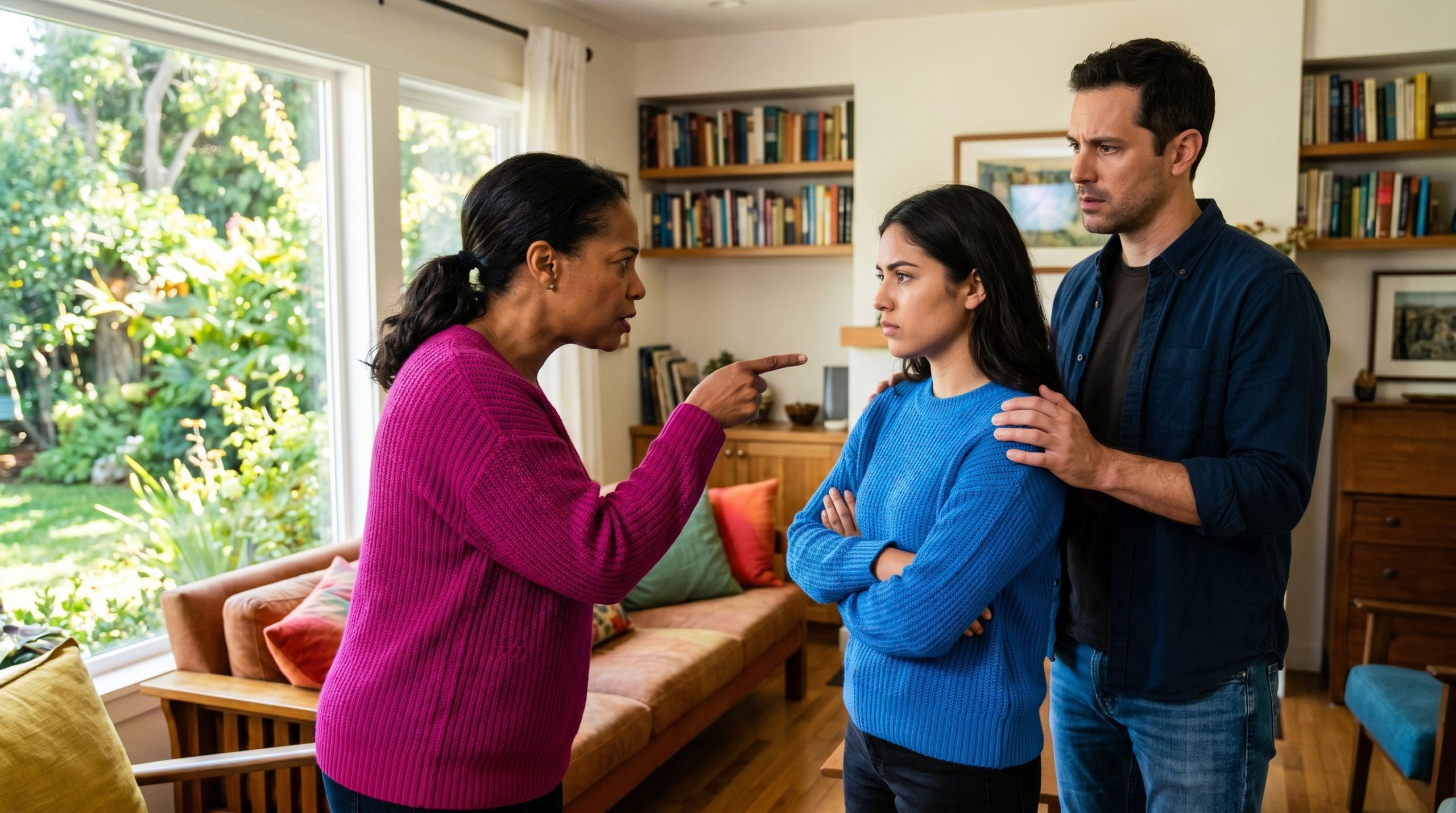
She hurried to make herself clearer.
“Lily is in a difficult spot. She’s dragging two children from one rented place to another. Her husband is always away for work, and there’s not much help from him. Here, everything is already set up. The house sits empty most of the time anyway. You only come out here now and then. No sense letting a good place go unused.”
Tara slowly turned her eyes toward her husband.
“Mark?”
He cleared his throat, rubbed the bridge of his nose, and began speaking in the tone of a man asking for something minor, as if he wanted to move a few bags of soil under the awning.
“Tara, don’t get worked up right away. Mom isn’t wrong. The house really is empty most of the time. Lily has kids; they need fresh air. They could stay for a while, keep an eye on the place. It would make things easier for you too.”
Tara pushed her mug aside. The clay scraped across the tabletop.
“Who is Lily?” she asked.
“My cousin’s daughter,” Linda answered at once. “She’s not some stranger.”
“Maybe she isn’t a stranger to you. To me, she is.”
“Oh, why do you have to take it that way?” Linda frowned. “Family is family.”
Tara stood up from the table. Not abruptly, not theatrically. She simply rose, walked over to the window, and looked out into the yard, where a box of seedlings pulled from the greenhouse sat on the ground. She could feel her face growing heavy, as if all the blood in her had settled there, and she knew that if she said one more word, her voice would harden. The thought did not frighten her. Sometimes people only understood when you spoke that way.
“Let’s make this clear,” she said without turning around. “Who invited anyone to live in my house?”
Behind her, a brief silence fell.
“Well… we talked it over,” Linda said, her confidence already thinning. “With Mark. He’s your husband. It concerns him too.”
Tara turned back.
“I didn’t ask who you discussed it with. I asked who gave the invitation.”
Mark finally lifted his head, though he still did not meet his wife’s eyes.
“I told Mom we could think about it,” he muttered. “Just think about it, Tara. No need for a scandal.”
“No need for a scandal?” she repeated. “You came to my inherited house, looked over the yard, the rooms, the shed, the bathhouse, discussed where somebody else’s beds would go, and your mother is already talking as if the move-in date has been settled. That’s what you call thinking about it?”
Linda visibly deflated. The earlier tone of a woman inspecting property that already belonged to her cracked down the middle, though she still tried to keep her composure.
“What is so terrible about it? I’m speaking like a human being. We’re not throwing anyone out into the street. Quite the opposite—the house would be watched. Does anyone stay here through the winter? No. But this way people would live here, heat the stove, shovel the snow, look after the yard.”
“My yard?” Tara tilted her head slightly. “On what grounds?”
“Because they’re in a hard situation.”
“Half the country is in a hard situation. That doesn’t give anyone the right to walk into someone else’s home and start dividing up the rooms while the owner is washing mugs in the kitchen.”
Mark jerked one shoulder.
“Don’t talk to my mother like that.”
“How should I talk? Should I listen while the two of you dispose of my property and just nod along?”
“There you go again with your property,” he said, irritation creeping into his voice. “We’re a family.”
Tara shot him such a look that he broke off mid-sentence. She hated when that word was used as a blanket to cover someone else’s nerve.
“Exactly because you are my husband, you should have been the first person to tell your mother: no, nothing is decided without Tara. Instead, you brought her here to show her the house.”
Linda exhaled loudly and tried once more to go on the offensive.
“Why are you making everything so complicated? They wouldn’t be here forever, only for a while. By fall, if they want, they’ll find something else. Or maybe things will get better for them. You’re talking as if this were a palace.”
“I’m not talking about a palace. I’m talking about my home. A house I inherited from Paula, a house I handled the paperwork for, repaired, and maintain. And no one is going to settle here just because it happens to be convenient for you.”
“So you don’t want to help?” Linda narrowed her eyes.
“Whether I want to or not is not even your question to ask. You didn’t come here to ask. You came here to give orders.”
Mark pushed back his chair and stood up sharply.
“Tara, let’s be calm about this. Fine, Mom phrased it badly. We can discuss it normally.”
“It should have been discussed before she started choosing a room for the children.”
Linda gave a short, scornful snort.
“My, how delicate we are. You grab onto one word and make a tragedy of it.”
“I’m not grabbing onto the words. I’m looking at what they mean.”
Tara crossed to the coat rack, took a set of keys off the hook, and placed them on the table in front of her husband.
“These are the keys you had, just in case?”
Mark nodded.
“Give yours back.”
“Right now?”
“Yes. Right now.”
He reached into his pocket, pulled out the key, and laid it beside the others without a word. The metal rang briefly against the tabletop. Tara closed both sets in her palm and went on, now completely calm, without any extra heat in her voice.
“Today you’ll have lunch, and then you’ll leave. From now on, no one comes here without calling first. I did not invite anyone to tour the house. I did not give anyone permission to live here. If someone from your side of the family already believes they can move in, tell them the answer is no.”
“Well, look at you,” Linda hissed through her teeth. “Suddenly the mistress of the estate.”
“Yes. The owner. Exactly.”
After that, the conversation lost its old shape entirely. Linda no longer spoke about spacious rooms. Mark no longer tried to pretend the matter would somehow smooth itself out on its own. They were still sitting in Tara’s kitchen, but the confidence with which they had entered the house had disappeared.
Lunch was strained. Linda tried a couple of times to start a harmless conversation about the weather and the seedlings, but each attempt faltered, and she fell silent again. Mark ate with his head lowered almost the entire time. Tara cleared the table, carried the scraps out to the chickens, and when she returned, she found Linda already in the entryway, nervously straightening the sleeves of her jacket.
“We should probably get going,” Linda said. “It’ll be late otherwise.”
Tara did not say, Good riddance, though the words came to mind. She only nodded and opened the door.
When the car disappeared around the bend, she remained by the gate for a long while. The air smelled of damp soil and smoke from a neighbor’s stove. It was the same day, the same plot of land, the same house, and yet something inside had shifted. Not because Linda had said too much. Tara had grown used to such behavior long ago. Something else was far worse: Mark had known all of it. More than that, he had taken part in it.
By evening, she walked through the house once more, closed every window, checked the shed and the bathhouse. On the top shelf of the pantry, where she almost never looked, she found neatly stacked boxes of children’s dishes—things Paula had once kept for the neighbor’s little girl.