
Tara remained in the pantry, looking at the boxes, and against her will she began to picture it: some Lily moving through these rooms as if she owned them, hanging her towels on Paula’s hooks, dragging in bags that did not belong there, setting children on stools so they could peer out the windows. And then, one day, saying with a satisfied little sigh, “Well, we’ve pretty much settled in now.”
That thought worked better than any coffee could have. Tara took out her phone and called the locksmith from the nearby town, the same man who had installed a new latch on her gate that fall.
“Could you come by tomorrow?” she asked. “I need the lock on the front door changed. And the one on the shed too.”
“I can make it after lunch,” he said.
“I’ll be waiting.”
The next day, she met him at the gate, showed him exactly what needed replacing, and made sure he took the old cylinders away with him at once. After that, she stopped by Nina’s house. Nina lived two doors down all year round and noticed everything that happened on the road.
“Nina,” Tara said, “if you see anyone near my yard with bags, call me right away. Especially if they tell you they were given permission.”
Nina threw up her hands.
“I was just about to tell you! Your mother-in-law came here last Saturday. And she wasn’t alone. There was some woman with her, and a boy. They stood by the fence, talking about where the garden was and where the bathhouse stood. I thought you knew.”
For several seconds, Tara only stared at her neighbor.
Now the last piece slid into place. This had not been a sudden conversation. It had not been a careless idea tossed out without thinking. It had not been rudeness in the heat of the moment. They had already shown the house. They had already brought someone to the fence. They had already discussed how convenient everything would be.
“Thank you for telling me,” Tara said quietly.
She returned to the city late that evening. The apartment was hers, bought before the marriage, a two-bedroom place. After the wedding, Mark had moved in with her. Once, that had seemed perfectly natural. Now it looked different. Lately, he had been acting far too much as though anything that belonged to someone else was automatically available to him. Not only the country house. Her time as well. Her strength. Her peace.
Mark met her in the hallway.
“Why weren’t you answering your phone?”
“I was busy.”
“Mom’s upset, just so you know.”
Tara took off her jacket, hung it on the hook, and only then looked at her husband.
“I changed the locks.”
He blinked.
“What locks?”
“At the house. And on the shed. No one else has keys now.”
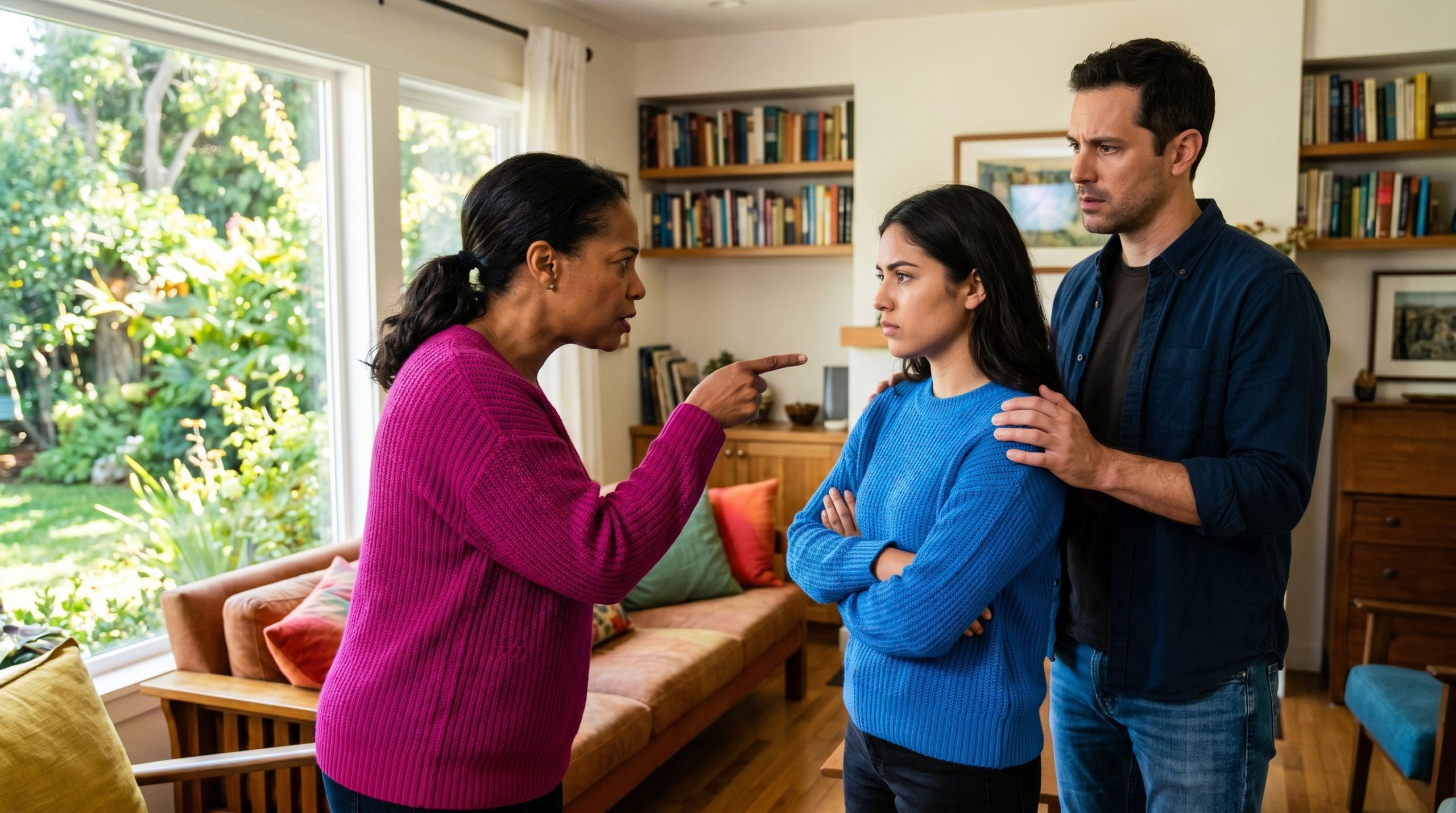
“Are you serious?” Mark’s voice rose. “What was the point of that circus?”
“The point is that your mother has already been bringing people there and showing them my property. My neighbor told me.”
He hesitated for one brief second, and that second was enough.
“So you knew,” Tara said.
“I wouldn’t say I knew…” he began. “Mom asked me to drive over and take a look. I didn’t think you’d fly off the handle like this.”
“I didn’t fly off the handle. I just decided I’m done being treated like a fool.”
Mark walked into the kitchen, pulled a bottle of water from the refrigerator, took several swallows, and when he spoke again, the irritation was no longer hidden.
“Tara, you always push everything to the limit. We could have helped like normal people. You don’t live there all the time. What, are you that greedy?”
Tara leaned one shoulder against the doorframe. Not a single muscle moved in her face, but her fingers curled tight.
“Greedy? No. What disgusts me is that all of you decided behind my back that what is mine is shared, and what is shared belongs to your mother. That is what disgusts me.”
“There you go again.”
“No, Mark. You started this. You started it when you drove your mother out there to look at someone else’s house as if it were vacant housing.”
He slammed the bottle down on the table so hard that water splashed over the rim.
“Someone else’s, someone else’s… Then what am I to you? A stranger?”
“You’re my husband. Which means you were supposed to protect my boundaries, not act like a broker for a takeover.”
“Listen to yourself. What dramatic words.”
“Accurate ones.”
Tara went into the bedroom, opened the closet, and took out a travel bag.
“What are you doing?” Mark snapped.
“Packing your things. You’ll spend tonight at your mother’s.”
“Have you lost your mind?”
“No. I’ve finally stopped pretending nothing serious happened.”
He stepped toward her.
“You have no right to throw me out.”
Tara turned so sharply that he stopped on his own.
“This apartment is mine. I bought it before we were married. And now you are going to leave by yourself, without a scene. Otherwise I’ll call the police and explain that a man is refusing to leave the owner’s home after a conflict.”
Mark stared at her as if he were seeing her for the first time.
Maybe he was. Before this, Tara had smoothed over too much. She had kept quiet when Linda criticized her cooking. She had not argued when Linda showed up without calling first. She had endured it when Mark promised to come help at the country house and then, at the last minute, found something more important to do. Each time she gave way over some small thing, she failed to notice how, in the eyes of that family, she was turning into a person who would swallow anything.
“Over a house?” he asked dully. “You’re destroying a family over a house?”
“Not over a house. Over the fact that you decided you could manage something that doesn’t belong to you. Today it’s the house. Tomorrow what? Who else will you bring into my life because your mother wants it?”
He kept trying to argue. He said Tara was being too harsh, that everything could have been settled, that his mother only wanted to help relatives. But his hands were already putting clothes into the bag. He yanked drawers open loudly, tossed T-shirts in, made as much noise as possible on purpose. Tara did not stop him. She stood by the window and listened, and at some point she realized she felt neither regret nor fear. Only exhaustion from a pretense that had gone on far too long.
Before leaving, Mark threw his keys onto the small table in the entryway.
“When you cool off, call me.”
“Don’t wait for that,” she replied.
The door shut behind him. Tara immediately turned the lock and removed the key from the inside. Then she went to the little table, picked up his set of keys, put it in a drawer, and only after that sat down.
Not on the floor. Not in hysterics. Not in some elegant pose from a TV drama. She simply lowered herself onto the bench in the hallway. For several minutes she sat motionless. Then she lifted her head, saw her reflection in the dark window glass, and suddenly let out a short, almost angry laugh.
So that was all it took. One time not staying silent, and people quickly remembered where their property ended and someone else’s began.
The next day, Linda called her herself.
“What do you think you’re doing?” she began, without so much as a hello. “Mark is sleeping at my place because of your little performance.”
“Not because of mine. Because of his.”
“You don’t value your husband at all. All this over some little house.”