
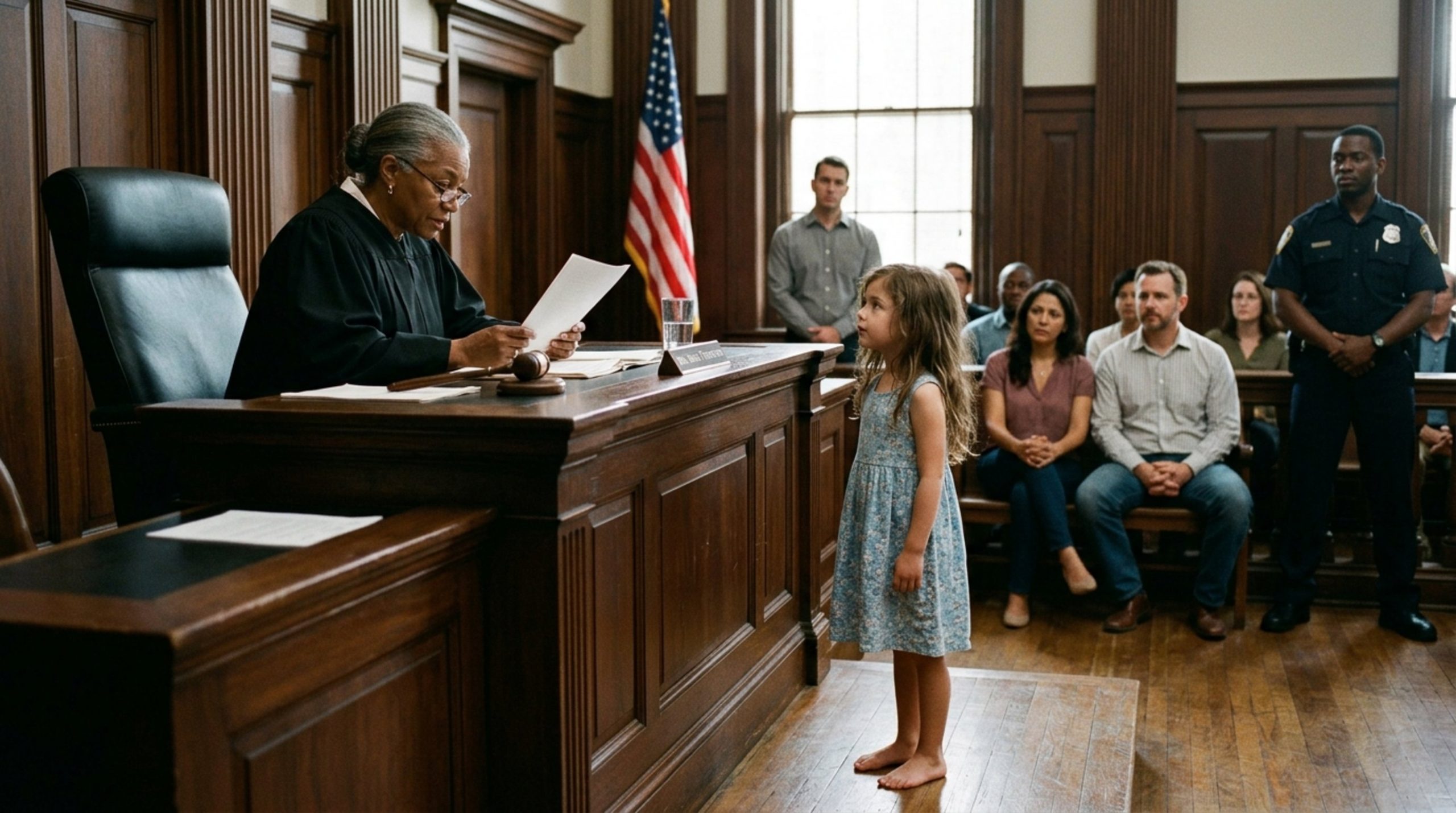
“Your Honor, if you let my daddy come home, I’ll help make his legs feel better.” — The courtroom fell into stunned silence when a six-year-old girl interrupted a felony trial, and the ruling that followed would alter everything.
The Day a Little Girl Walked Into My Courtroom
For as long as I had served on the bench in Cedar Hollow, Pennsylvania, the courtroom had been a place defined by order and reason. It was a chamber where emotion was filtered through statutes and precedent, where even the most heartbreaking accounts were distilled into exhibits and sworn testimony.
But on that cold morning in February, the atmosphere shifted in a way no legal manual could ever anticipate. A small child slipped out from the gallery benches and made her way toward the bench where I presided. In those suspended seconds, every whisper dissolved. Even the faint rustle of papers seemed to vanish into the high ceiling above us.
I had spent more than twenty years hearing criminal cases. For the last four, I had done so from a wheelchair, ever since a highway collision left my legs paralyzed and forced me to rely on others for the simplest physical tasks—though I rarely allowed that dependence to show. Pain had become a quiet companion, a steady pulse beneath my ribs, but I had trained my face and voice never to betray it.
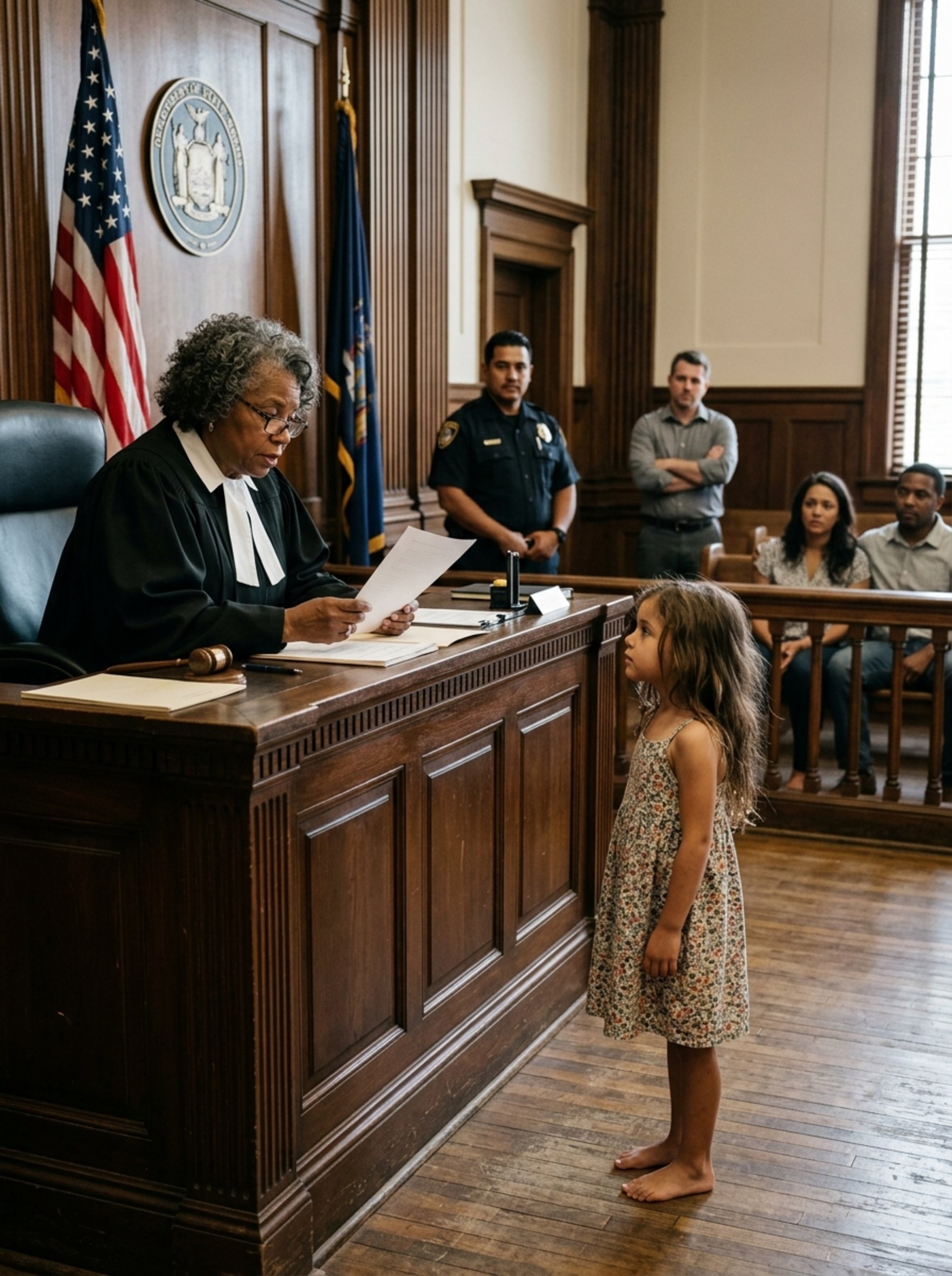
My name is Margaret, and I have always believed that the authority of a court does not arise from physical strength, but from clarity of mind and steadiness of judgment. I learned to rest my hands calmly on the armrests and to speak in an even tone, even on days when the ache in my spine reminded me of everything I had lost.
That morning, seated at the defense table to my right, was a man named Jason. He worked as a warehouse technician and had no prior record. His shoulders curved inward, as though he were attempting to shrink into a smaller version of himself.
He stood accused of stealing prescription medication from a neighborhood pharmacy. The quantity taken was not large, yet the prosecution pursued felony charges because the drug was expensive and tightly regulated. The state intended to make an example of him.
When the little girl reached the open space before the bench, I first noticed the soft squeak of her shoes against the polished floor. Then I saw the way her dark-blonde hair had fallen across her forehead, as if someone had tried—hurriedly and without much success—to smooth it back that morning.
Her coat was far too thin for winter. Beneath it, the hem of a worn dress peeked out. The fabric was faded but spotless, carefully washed and pressed, suggesting that someone in her life fought hard to preserve dignity despite hardship.
She stopped a few feet from the bench and looked up at me with a gaze so direct and unwavering that something tightened in my chest.
“Your Honor,” she said, placing her tiny hands on the wooden railing, “if you let my daddy come home, I’ll help make his legs feel better.”
Her words rippled through the room like a stone breaking the surface of still water. People shifted uneasily. From the back row came a short exhale that might have turned into laughter—until they saw that I was not amused.
I did not smile. Over the years, I had learned that children rarely speak without believing every syllable. There was no mockery in her voice, no performance. Only earnest conviction.
To understand how she came to stand in that aisle, we must step back three weeks, to a modest duplex on the edge of town where Jason lived with his daughter, Lily. The pale blue paint on the narrow porch railing had begun to peel, curling away in thin strips from years of harsh weather.
Jason worked nights at a regional distribution warehouse that shipped medical equipment across western Pennsylvania. The job was steady but exhausting, demanding long hours on concrete floors under harsh fluorescent lights. His pay was modest—just enough, most months, to keep the lights on and food in the refrigerator, but never enough to provide any real sense of security.