
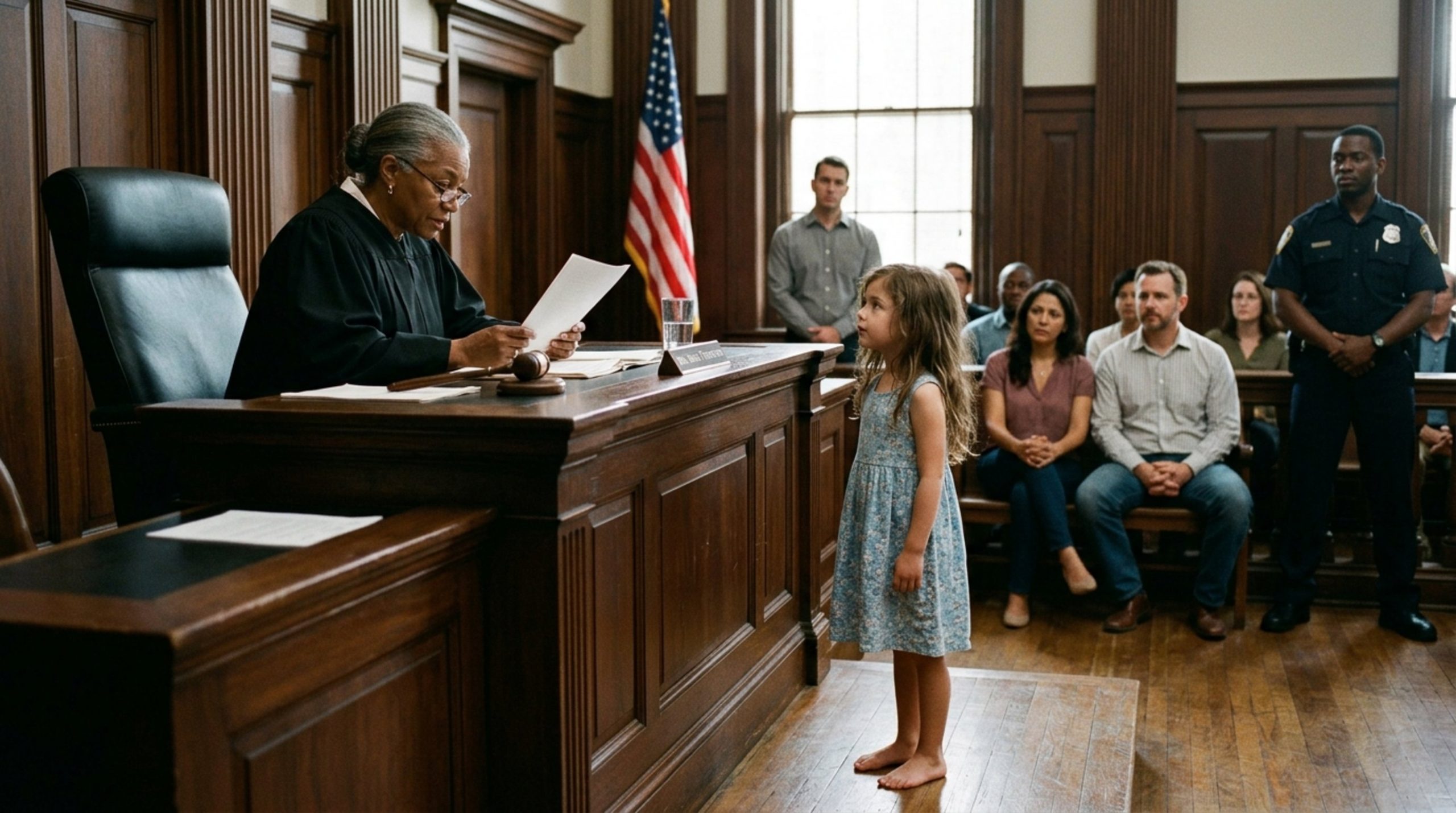
I then described the sentence I intended to impose—one that would place Jason on supervised probation, require him to complete a set number of service hours with a local medical outreach initiative, and establish a restitution schedule he could realistically manage in installments. It was an alternative to incarceration, which would have separated him from his daughter and likely deepened the very hardship that had led him into this courtroom.
A ripple moved through the gallery again, but the tone had shifted. The earlier sharpness had given way to something more reflective, almost uncertain.
I concluded with deliberate clarity. “This court believes that accountability and compassion are not mutually exclusive. Mr. Hale, I am extending you a measure of trust. I expect you to prove it was not misplaced.”
Jason’s eyes brimmed as he nodded. For a moment he couldn’t speak. When he finally did, his voice wavered.
“I won’t waste it, Your Honor. I give you my word.”
An Unexpected Lesson
After the hearing adjourned and the room gradually emptied, Lily approached once more, this time accompanied by her aunt, who offered a quiet apology for the earlier interruption.
Lily positioned herself beside my wheelchair and said in a near whisper, “I still want to show you the breathing thing.”
Ordinarily, I might have declined. The bench had taught me caution—about boundaries, about maintaining distance. But curiosity, and perhaps something gentler, overruled that instinct.
“All right,” I said softly. “Show me.”
She placed her small palm against her chest and instructed me to inhale slowly to a count of four, then release the breath to a count of six. Her mother, she explained, had told her that breathing this way helps the body “remember” how to move when it feels stuck.
We repeated the pattern several times. I knew, of course, that no measured breath would restore sensation to my legs. Yet as I followed her count, I felt a subtle warmth spread through my chest, as though a long-held tension had begun, at last, to loosen.
When they prepared to leave, Lily looked up at me with quiet certainty. “See?” she said. “It helps.”
I smiled—not because I believed in sudden cures, but because I understood something new in that moment. Healing does not always announce itself in medical charts or dramatic recoveries. Sometimes it reveals itself in quieter, less visible ways.
What Remained With Me
In the weeks that followed, I often revisited that morning in my thoughts—the way a child’s simple act reframed an entire proceeding, and the delicate line judges must walk between enforcing the law and recognizing the humanity of those who stand before us.
Jason began his community service at a clinic providing low-cost medical care. He assisted with maintenance, organized supply deliveries, and handled whatever logistical tasks were needed. The reports submitted to the court described steady effort and an unassuming dedication to the work.
Lily’s condition stabilized after she regained consistent access to her medication through a state assistance program—one her public defender helped secure. Meanwhile, the pharmacy on Brookline Avenue established a modest emergency fund for families in crisis, supported in part by donations from local residents who had followed the case.
As for me, I remained on the bench, my wheelchair still a constant companion. And yet, something within my perspective had undeniably shifted.
For years, I had believed that my role demanded emotional restraint—that empathy must be carefully rationed, lest it blur into partiality. But Lily’s unguarded sincerity reminded me of a deeper truth: justice is not diminished by compassion. On the contrary, it gains strength when it acknowledges the complex, fragile realities of the people it serves.
Now, on certain late afternoons when the courthouse grows quiet and sunlight filters through the tall windows, I practice the exercise she taught me. I breathe in slowly, counting. I breathe out even more slowly. The steady rhythm anchors me to the present moment.
My legs remain unchanged. That has not shifted. Yet my understanding of what it means to help someone has widened. And in that sense—quietly, without spectacle—a little girl managed to bring something within me back to life.